
How to Stop Shepherd Puppy Crate Screaming: A Calm Plan for Ending “Crate Chaos”
Table of Contents
You bought a crate to keep your Shepherd puppy safe, support potty training, and prevent late-night destruction. Instead, the moment the door closes, your home erupts with high-pitched screaming, frantic barking, howling, digging, and teeth scraping against metal bars.
Now you are overwhelmed. You cannot sleep. You cannot leave the house without feeling guilty. Even walking into another room can trigger what sounds like a full-scale emergency. You’re wondering whether to comfort your puppy or “let them cry it out.”
First, take a breath.
Crate screaming does not automatically mean your puppy is stubborn, manipulative, “dominant,” or impossible to train. In most cases, the behavior means the training progressed faster than the puppy’s ability to remain calm.
German Shepherds, Dutch Shepherds, Belgian Shepherds, high-drive Shepherd mixes, and similar working puppies can become intensely frustrated when they lose access to their person, their environment, or the activity happening around them.
At Shepherd SOS, we treat behavior as information. The screaming is the symptom. The missing skill is tolerating confinement, separation, frustration, and inactivity without escalating into panic.
The goal is not to force your puppy to “cry it out” until it becomes silent. The goal is to teach your puppy that the crate predicts safety, rest, food, and your eventual return.
This guide explains how to stop a shepherd puppy from crying in the crate using gradual exposure, positive reinforcement, better scheduling, and realistic expectations.
It also explains when barking is ordinary protest, when it is true distress, and when the crate may not be the right management tool yet.
What Is “Crate Chaos”?
“Crate chaos” is the frantic behavior that begins when a puppy is confined or realizes the handler is moving away.
It may include:
Barking, whining, screaming, or howling
Digging at the crate floor
Biting or pulling on the bars
Spinning, pacing, or repeatedly changing positions
Throwing their body against the door
Refusing food that they normally love
Panting or drooling when the room is not hot
Urinating or defecating despite having recently gone outside
Becoming more distressed when the owner leaves the room
Although these behaviors can look similar, they do not always have the same cause.
A puppy may be vocalizing because they need to potty. They may be overtired, fighting sleep, unprepared because the fun stopped, or frustrated because barking has previously gotten them out.
Other puppies experience genuine confinement distress. Some remain calm when left in a puppy-proofed room but panic when enclosed in a crate.
Others become distressed whenever their person leaves, regardless of whether they are in a crate, exercise pen, or open room.
That distinction matters.
A puppy who complains for a minute and then settles needs a different training plan from a puppy who bites crate bars, injures their mouth, soils themselves, or becomes increasingly frantic with every passing minute.
Crate training should therefore begin with observation, not assumptions.
Why Shepherd Puppies Can Make Crate Training Feel Extreme
German Shepherds, Belgian Malinois, Dutch Shepherds, and many Shepherd mixes are observant, energetic, fast-learning dogs. Their awareness of movement, people, sounds, and routines can make confinement especially frustrating at first.
A Shepherd puppy may struggle because:
The crate predicts your departure.
They have never practiced being separated from you.
They are too stimulated to settle.
They are overtired.
The room is full of visual triggers.
Crate duration increased too quickly.
They have learned that screaming sometimes opens the door.
The Shepherd SOS approach is not to suppress that intensity. It is to give it structure.
Reduce unnecessary arousal. Prevent repeated panic. Reinforce the small moments of calm you want to see again.
Why “Let Them Cry It Out” Can Backfire
Some whining is normal. You do not need to open the crate every time your puppy makes a sound.
But “ignore them no matter what” is not a complete training strategy.
If a puppy is demand barking, opening the crate during the loudest moment can reinforce the behavior.
If the puppy is genuinely panicking, however, allowing them to escalate for an hour may make the crate more frightening and increase the risk of injury.
The goal is neither instant rescue from every whine nor endless exposure to distress.
The goal is to keep training below the puppy’s panic threshold while gradually increasing what they can handle.
First, Identify Why Your Puppy Is Screaming
Before another crate session, run through the Shepherd SOS safety check to ensure the environment is not working against you.
1. Does Your Puppy Need to Potty?
Young puppies have limited bladder and bowel control. Nighttime whining after several hours of sleep may be a legitimate request, not manipulation. Take the puppy outside calmly on a leash, give it a brief opportunity to eliminate, and return directly to the crate without play or excitement.
2. Is Your Puppy Overtired?
Many owners assume a screaming shepherd puppy needs more exercise. Often, the puppy needs more sleep.
Puppies commonly need anywhere from 16 to 20 hours of sleep per day. High-intensity fetch, wrestling, chase, or frantic play immediately before confinement may leave a puppy physically tired, but neurologically wired.
Without planned naps, they can become mouthier, louder, more impulsive, and less able to settle.
A puppy awake through training, play, visitors, and household noise may enter the crate with an already overloaded nervous system.
3. Is the Crate Comfortable and Safe?
Check the temperature, airflow, bedding, crate size, and location.
The crate should allow your puppy to stand, turn around, stretch, and lie comfortably. A divider can reduce excess space during potty training, but the puppy should never be cramped.
Remove collars, tags, slip leads, and harnesses before unsupervised crating because they can catch on crate hardware.
Use crate covers carefully: reduce visual stimulation while preserving ventilation and preventing the puppy from pulling fabric through the bars.
4. Is It Protest, Frustration, or Panic?
Mild protest usually has pauses. The puppy may take food, look around, lie down briefly, or respond to your presence.
Distress tends to escalate. The puppy may pant heavily, drool, refuse high-value food, repeatedly launch at the door, bite the bars, eliminate, or remain unable to recover.
When a puppy shows severe or escalating distress, stop treating the session as an obedience contest. Change the setup, use a puppy pen or safe room if that is easier, and seek qualified professional or veterinary guidance if the pattern continues.
Prerequisites and Tools Needed
Before beginning a Shepherd puppy crate training plan, make sure the environment supports success.
A Properly Sized Crate
A crate that is too small is uncomfortable. A crate that is unnecessarily large may make house-training more difficult because some puppies sleep on one side and eliminate on the other.
For a growing Shepherd puppy, an adult-size crate with a secure divider is often the most practical option.
A Crate Cover or Visual Barrier
A fitted cover can reduce visual stimulation and make it easier for an alert puppy to disengage from the room.
Start by covering two or three sides while maintaining airflow. Complete darkness is not automatically better for every dog. Watch whether your puppy relaxes or becomes more concerned when the crate is covered.
Never drape loose fabric where the puppy can pull it through the bars and swallow it.
High-Value “Crate-Only” Toys & Enrichment
Reserve certain safe food toys or enrichment activities for crate sessions.
Options may include:
A durable food-stuffed rubber toy
Soaked and frozen puppy food
A frozen portion of the puppy’s normal meal
A veterinarian-approved chew
A licking activity your puppy has already used safely
Avoid introducing a new chew and immediately leaving the puppy unsupervised with it. Observe how your puppy uses each item first.
When using peanut butter, confirm that it does not contain xylitol, an ingredient that is highly toxic to dogs.
A Safe Alternative to the Crate
Some puppies are not ready for extended crate confinement.
A securely gated, puppy-proofed room or exercise pen may temporarily provide safer management while you continue short crate-training sessions separately.
Using an alternative does not mean you have failed. It means you are preventing repeated panic while teaching the skill at a pace your puppy can handle.
A Predictable Daily Routine
Crate training becomes harder when the puppy’s day is chaotic.
A young Shepherd puppy needs appropriate potty breaks, sleep, food, movement, mental enrichment, social interaction, and opportunities to explore.
The crate should fit into that routine rather than being used whenever the puppy becomes inconvenient.
Think:
Potty → sniffing or calm activity → short training → potty → enrichment → crate → rest
That sequence alone can dramatically change how some puppies settle.
The Step-by-step Shepherd SOS Crate Training Plan
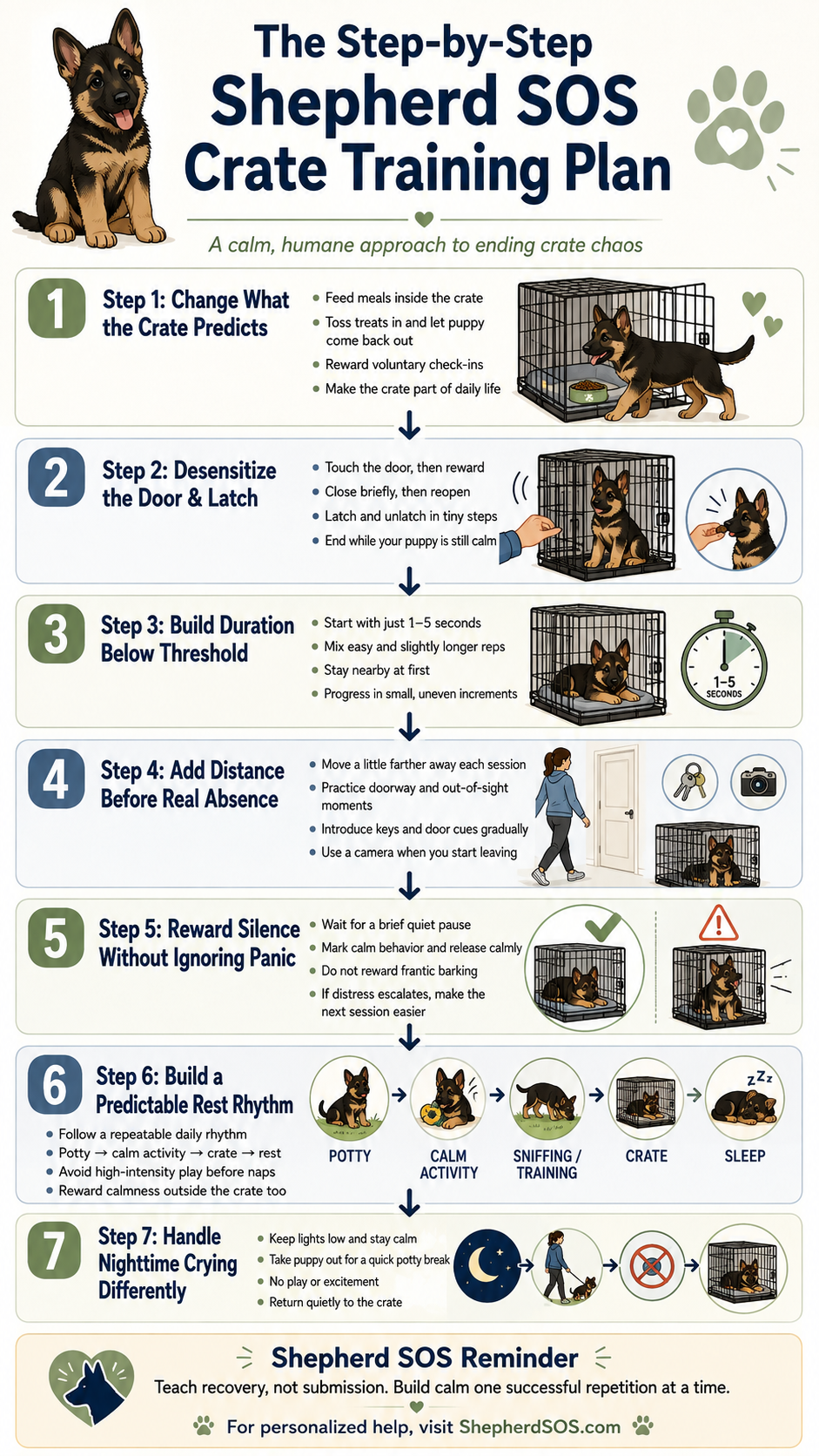
Step 1: Change What the Crate Predicts
If the crate only appears when you leave or fun ends, your puppy has little reason to like it.
Make the crate part of ordinary life.
Feed meals inside with the door open.
Toss treats in and let your puppy walk right back out.
Hide surprise kibble inside when they are not watching.
Reward voluntary visits.
Give special food toys there.
Do not drag or force a frightened puppy inside.
You want your puppy thinking:
“Interesting things happen in here.”
Not:
“This is where I get trapped.”
Step 2: Desensitize the Door and Latch
For many puppies, entering is easy. The door is the problem.
Break it down:
Puppy enters—reward.
Touch the door—reward.
Move it slightly—reward.
Close it halfway—reward.
Close it without latching—reward and reopen.
Latch and immediately unlatch.
Close it for one second, then two, then five.
Do several tiny sessions instead of one long battle.
Avoid increasing difficulty every repetition. Try:
1 second → 3 seconds → 1 second → 5 seconds → 2 seconds
Easy repetitions build confidence.
If your puppy suddenly stops eating, freezes, rushes the door, or becomes frantic, the exercise has become too difficult. Go back one step.
Step 3: Build Duration Below Threshold
Once the door can stay closed, build duration while you remain nearby.
Sit beside the crate. Read. Work. Fold laundry. Be boring.
You are teaching confinement before isolation.
Gradually increase calm crate time, but do not jump from five successful minutes to thirty just because things went well once.
A good session ends before your puppy loses control.
That leaves the puppy with a history of successful repetitions instead of repeated explosions.
Step 4: Add Distance Before Real Absence
When your puppy can relax while you are nearby, begin adding distance.
Walk across the room. Return.
Touch the doorway. Return.
Disappear for one second. Return.
Close an interior door briefly. Return.
Pick up your keys without leaving.
Open the exterior door.
Eventually, step outside briefly.
A camera is extremely useful here. It shows whether your puppy settles after you leave or whether distress begins the moment you disappear.
Increase absence before panic begins, not after.
Step 5: Reward Silence Without Ignoring Panic
This is where crate advice often becomes confusing.
For mild protest barking, avoid opening the door during the loudest moment. Wait for a brief pause, mark the quiet with “yes,” and calmly release your puppy if the session is finished.
But if your puppy is throwing themselves against the crate, biting bars, drooling, trembling, or becoming increasingly frantic, do not wait indefinitely for perfect silence.
The session exceeded their capacity.
Instead:
End it calmly and safely.
Check for potty or physical needs.
Make the next repetition easier.
Use a pen or puppy-proofed room if necessary.
Seek professional help if severe distress continues.
The lesson is not simply “noise never works.”
It is:
“Calm is achievable, safe, and consistently rewarded.”
Step 6: Build a Predictable Rest Rhythm
Many cases of Shepherd puppy crate screaming are partly schedule problems disguised as crate problems.
Overtired puppies often look more energetic, not less.
They bite harder. Zoom around the house. Stop listening. Bark at everything. Fight sleep.
Owners sometimes respond with even more exercise, creating an overstimulation loop.
Instead, build a predictable cycle:
Potty break → calm exploration or sniffing → low-intensity training session → quiet enrichment → another potty opportunity → crate reward → sleep
Practice calmness outside the crate too. Reward mat work, quiet chewing, relaxed observation, and voluntary rest.
A high-drive puppy does not only need an “off switch.”
They need you to teach them how to use it.
Step 7: Handle Nighttime Crate Crying Differently
A puppy crying at 3:00 a.m. may actually need to eliminate.
Take them outside calmly.
Keep lights low.
Use a leash.
Avoid playing or exploring.
Give them a quiet chance to potty.
Return directly to the crate.
Nighttime potty trips should meet the physical need without becoming entertainment.
Do not rely rigidly on the “age in months equals hours” rule. Bladder capacity varies, and puppies need appropriate opportunities to potty, move, interact, and engage with their environment.
Troubleshooting Common Crate Problems
“My Puppy Sleeps in the Crate at Night but Screams During the Day.”
Nighttime is darker, quieter, and more predictable. During the day, the puppy may hear movement, see people, or believe they are missing an activity, aka Fear of Missing Out (FOMO).
For younger puppies, place the crate or pen near your daytime workspace at first. Practice short naps while you remain visible, then gradually increase the distance and reduce visual access.
“My Puppy Screams Only When I Leave the Room.”
This is an alone-time skill problem, not only a crate problem. Practice separation behind a baby gate or exercise pen where the puppy can still see you. Teach calm independence during ordinary moments rather than saving all separation practice for departures.
“My Puppy Bites the Bars and Digs Frantically.”
Stop what you’re doing and assess your puppy.
Occasional frustration is one thing. Forceful escape attempts are another.
Check for heat, pain, potty urgency, poor crate setup, excessive confinement, and overtiredness.
If your puppy is biting hard enough to damage teeth, nails, gums, or skin, stop forcing extended crate sessions and seek veterinary or behavior support.
“My Puppy Soils the Crate.”
Confirm that your puppy had a proper potty opportunity, the crate is not oversized, and the schedule is realistic. Also consider intestinal upset, urinary issues, parasites, stress, or a history of being forced to eliminate in confinement.
Repeated accidents deserve veterinary attention, especially if they are sudden, frequent, accompanied by diarrhea, or continue despite appropriate breaks.
“My Puppy Ignores the Frozen Food Toy.”
A puppy who normally loves food but refuses it during confinement may be too stressed to eat.
Shorten the session, remain closer, leave the door open, or train in a pen. Do not keep upgrading the food while ignoring the emotional message.
Crate Training Was Improving but Suddenly Regressed
Regression can follow:
A frightening sound
An unusually long crate session
Illness or digestive discomfort
Teething pain
A change in household routine
Moving the crate
A new animal or person in the home
Adolescence
Repeated departures that exceeded the puppy’s ability
Return to easier repetitions. Regression is information, not defiance.
Frequently Asked Questions
How Long Can a Shepherd Puppy Stay in a Crate?
There is no responsible one-number answer.
Age, health, bladder control, previous training, sleep schedule, and emotional comfort all matter.
Daytime crating should be broken up with potty opportunities, movement, social interaction, training, and age-appropriate enrichment. A crate is a management and rest tool—not a substitute for meeting a shepherd puppy’s developmental needs.
Build duration gradually. A puppy may physically avoid an accident while still needing movement, social contact, training, enrichment, and normal exploration.
Don't use crates to store a high-energy shepherd puppy for most of the day.
Should I Ignore My Puppy at 3:00 A.M.?
Not automatically.
Young puppies will genuinely need a potty break in the early morning. Take the puppy outside calmly on a leash, keep the lights low, avoid play and conversation, and provide a brief opportunity to eliminate.
Then return directly to the crate.
The trip should meet the physical need without becoming a rewarding nighttime adventure.
Should the Crate Be in My Bedroom?
For many young puppies, yes. A crate beside the bed can reduce isolation, help you respond to legitimate potty needs, and support gradual adjustment. You can move it farther away over time if the dog will eventually sleep elsewhere.
Is My Puppy Experiencing Separation Anxiety?
Not every barking puppy has separation anxiety.
Some puppies experience ordinary protest, barrier frustration, boredom, potty urgency, or incomplete crate training. More concerning signs include immediate panic, heavy panting, drooling, frantic escape attempts, inability to eat, elimination caused by distress, and similar behavior whenever the owner leaves.
A camera can help identify what happens during your absence. Discuss severe or persistent symptoms with a veterinarian and a qualified behavior professional.
How Quickly Will Crate Screaming Stop?
Some puppies improve within several days once their sleep, potty schedule, and training steps are corrected. Others need several weeks. Severe confinement distress, medical discomfort, or separation-related anxiety may require a customized plan.
Progress is more than silence. Look for faster recovery, softer body language, willingness to enter, improved food engagement, longer naps, and greater comfort when you move away.
What If My Puppy Is Calmer in an Exercise Pen?
Use the safer option while continuing gradual crate training separately.
The immediate goal is not proving that your puppy must tolerate one specific piece of equipment. The goal is safe management without repeatedly rehearsing panic.
A crate is a valuable life skill, but it is not the only way to create a secure puppy area.
When to Get Professional Help
Seek help when your Shepherd puppy:
Injures their teeth, gums, face, paws, or nails
Bends bars or repeatedly escapes
Pants, drools, trembles, or soils the crate from distress
Cannot tolerate the closed door for even a few seconds
Panics whenever you leave, even outside the crate
Suddenly develops crate fear after previously resting comfortably
Shows signs of illness, pain, vomiting, diarrhea, or urinary changes
Continues becoming more distressed despite gradual training
A crate is a management tool and a trainable life skill. It is not a cure for every anxiety or separation problem. Professional guidance is especially important when panic, self-injury, or a medical issue may be present.
Bottom Line: Teach Recovery, Not Submission
Your German Shepherd puppy is not giving you a hard time; they are having a hard time with a skill they have not mastered yet.
Crate training improves when you address the whole system:
Safety. Health. Potty timing. Sleep. Predictable routines. Gradual exposure. Emotional thresholds. Calm reinforcement.
Do not make the crate a battle of wills. Make it a structured lesson in recovery and independence.
We are not merely stopping noise. We are helping the puppy develop frustration tolerance, emotional regulation, independence, and the ability to recover after excitement.
Start smaller than you think you need to. Reward calmness before the explosion. Protect your puppy’s sleep. Stop repeatedly rehearsing panic. Build confinement before isolation, and build isolation before long absences.
Some Shepherd puppies improve noticeably after several days of consistent training. Others require several weeks, environmental changes, or a fully individualized behavior plan.
The speed of the process is not the standard. The emotional stability of the final behavior is.
Want To Accelerate Your Crate Training?
Access our free Puppy Crate Training Schedule Generator to create an exact hour-by-hour breakdown of crate time, potty breaks, and play sessions with a tap or click of a button!
👇 Fill out the form below to get instant access.
When Generic Training Advice Is Not Enough
You can absolutely use this guide to begin fixing crate chaos yourself.
But when you are trying to determine whether the real problem is overtiredness, barrier frustration, separation distress, poor timing, an inconsistent routine, or several factors at once, the fastest path is often to have someone help you connect the pieces.
That is what the Shepherd SOS Consult Call is built to do.
Instead of piecing together dozens of videos, Reddit threads, and conflicting training methods, you get a practical plan built around your Shepherd puppy, your schedule, your home, and the behavior you are actually seeing.
If crate screaming is only one part of a bigger pattern—biting, overarousal, inability to settle, leash chaos, reactivity, or a daily routine that feels impossible—the problem may not be the crate at all.
It may be the missing structure surrounding it.
Get personalized Shepherd puppy training help from Shepherd SOS.
Recommended Articles



Stop Shepherd leash pulling, lunging, and leash biting with a practical, reward-based plan for calmer walks, better focus, and safer handling.