
How to Stop Shepherd Leash Pulling: Fix Lunging, Leash Biting, and Wild Walks
Table of Contents
Walking your Shepherd puppy was supposed to be the peaceful part of the day.
Instead, the door opens, and your puppy becomes a four-legged tow truck—dragging toward smells, lunging at dogs, fixating on cars, and grabbing the leash like a tug toy.
By the time you return home, your shoulder hurts, your puppy is more overstimulated, and neither of you enjoyed the walk.
The good news is that wild leash behavior does not mean your shepherd is dominant, stubborn, aggressive, or impossible to train. It usually means the puppy has not learned how to regulate excitement, move at a human pace, disengage from distractions, or understand leash pressure.
Loose-leash walking is actually a collection of skills: handler awareness, impulse control, frustration tolerance, recovery after excitement, and the ability to keep moving without constant tension. That is a demanding assignment for an alert, fast-moving working breed.
This guide explains how to stop a shepherd from leash pulling without turning every outing into a correction battle. Your puppy will learn one clear rule:
A loose leash makes the world open. A tight leash pauses or redirects forward movement.
Leash Pulling and Leash Reactivity Are Not the Same
Leash pulling is forward pressure. Your puppy wants to reach a smell, person, dog, patch of grass, or destination faster than you are walking.
Leash reactivity is a stronger emotional response that may include staring, freezing, barking, whining, spinning, growling, or lunging.
Some dogs are afraid. Others are frustrated because they cannot greet. Fast-moving objects like cars, bikes, and runners may trigger chasing or herding instincts.
That distinction matters.
The explosion may look similar even when the emotion underneath it is different.
A puppy pulling toward a fire hydrant needs clearer walking rules. A puppy barking because another dog feels unsafe needs distance and gradual behavior work. A shepherd chasing cars requires immediate safety management and controlled training far from traffic.
Before correcting the symptom, identify what the puppy wants, how close the trigger was, whether the puppy could still respond, and how stressed or tired they already were. The cause should shape the training plan.
Why Shepherd Puppies Pull So Hard
Shepherds and shepherd mixes were developed to notice movement, cover ground, respond quickly, and stay highly aware of their environment.
In puppyhood, those traits can look like forward drive, motion sensitivity, frustration, fixation, and rapid escalation.
The leash blocks immediate access but does not teach an alternative. Pulling also tends to work: one strained step after another eventually reaches the tree, dog, or scent.
Shepherd puppy leash training must therefore teach a clear, rewarding replacement pattern.
Why Traditional Loose-Leash Advice Often Fails
“Just stop every time they pull.”
Stopping can work, but standing motionless for long periods may frustrate an already aroused puppy. Some begin spinning, jumping on the handler, or attacking the leash.
Use stopping as one option—not your only option. Combine it with direction changes, rewards, easier locations, and planned sniff breaks.
“Tire them out before the walk.”
A little appropriate activity may help, but frantic fetch, wrestling, or highly arousing tug immediately before leaving can make an already hot nervous system even hotter.
The goal is regulation, not exhaustion.
“Correct them harder.”
Leash jerks and painful equipment may interrupt pulling without teaching engagement or emotional control. Shepherd SOS focuses on reward-based training, clear boundaries, and safe management.
“Use a retractable leash for more freedom.”
Retractable leashes maintain changing tension and let a dog gain distance by pulling. They can also make a fast, powerful puppy harder to control near roads, people, and dogs. Use a fixed six-foot leash for early leash training.
Use a safe long line for intentional freedom in an appropriate open area instead.
Tools for Shepherd Puppy Leash Training
Use a simple, safe setup.
A fixed six-foot leash: Choose secure nylon, biothane, or leather. Do not wrap it around your wrist or fingers.
A well-fitted harness: A front-clip or dual-clip harness can improve control, but your puppy must still learn the loose-leash rule.
A conditioned head halter, when appropriate: A head halter can help manage a strong dog, but it must be introduced gradually. Never jerk the leash or allow the dog to hit the end at speed, because sudden force can injure the neck. Use a backup connection to a harness.
High-value rewards: Bring tiny pieces of meat, cheese, or another reward your puppy values outdoors. For some dogs, permission to sniff or move forward is even more powerful than food.
An optional backup line: For repeated leash biting, a second lightweight leash can let you transfer control instead of pulling back and creating a tug game. Never drop both lines in an unsecured area.
How Quickly Will Leash Pulling Improve?
Many owners notice progress within one or two weeks of consistent practice in easy environments, but reliable neighborhood walking takes longer.
A shepherd may understand the rule indoors and lose it near dogs, wildlife, traffic, or unfamiliar places. Training must progress gradually, and dependable manners often continue developing through adolescence.
Measure longer stretches of slack leash, faster check-ins, shorter biting episodes, and easier recovery from distractions.
The Shepherd SOS Loose-Leash Protocol
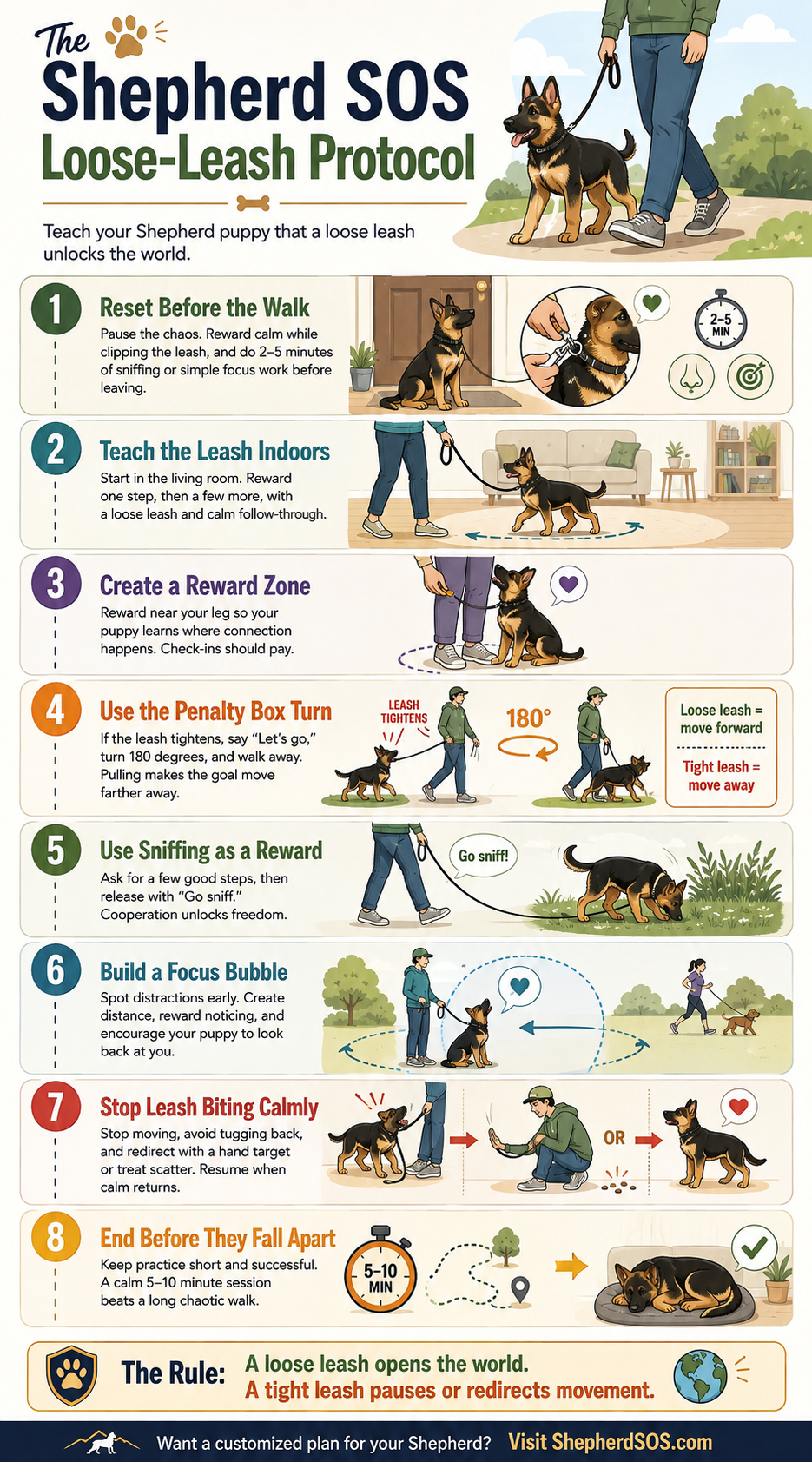
Step 1: Reset Before the Walk
If your puppy is already barking, spinning, jumping, and biting the leash before the door opens, the walk has started above the threshold.
Do not wrestle the harness onto a tornado.
Pick up the equipment. If chaos begins, pause. The moment all four feet return to the floor, or the puppy offers one second of stillness, calmly continue.
Reward calm behavior during each part of the routine: approaching the harness, standing while it is secured, allowing the leash to clip on, and waiting briefly at the door.
Before leaving, spend two to five minutes on food scatters, hand targets, slow position changes, or a simple sniff search. Controlled tug may help some puppies, but skip it if it increases arousal or leash biting.
The objective is a thinking puppy, not an exhausted one.
Step 2: Teach the Leash Indoors
Your living room is not too easy. It is where the rule becomes clear.
Clip the leash to the harness and reward your puppy beside you. Take one step. If the leash stays loose, mark with “yes” and reward again.
Build from one step to three, five, and ten. Practice turns, stops, speed changes, and following a cheerful “Let’s go.”
Keep sessions between two and five minutes. Then progress to the backyard, hallway, driveway, or another low-distraction area. Do not jump directly from the kitchen to a crowded trail.
Step 3: Create a Reward Zone
Choose where you want your puppy to return during structured walking. This does not need to be a competition, heel. The puppy may walk slightly ahead or beside you, provided the leash stays slack, and they remain responsive.
Deliver food close to your leg. Feeding far ahead can accidentally encourage forging.
At first, reward every few steps. Later, reward turns, voluntary eye contact, calm responses to sounds, and longer stretches of loose leash. This builds a strong history for the correct position.
Step 4: Use the “Penalty Box” Direction Change
Your puppy must learn that pulling does not move them closer to the goal.
Choose a low-level target such as a tree or patch of grass. Walk toward it. The moment the leash tightens, say “Let’s go,” turn 180 degrees, and move several steps away.
Do not yank the puppy. Turn smoothly and encourage them to follow. Once the leash softens and the puppy reconnects, approach again. Access is earned only while the leash remains loose.
Loose leash: we approach.
Tight leash: the opportunity moves away.
Reward-based loose-leash guidance uses the same principle: pulling delays access, while slack-leash behavior allows movement.
If your puppy cannot succeed after several attempts, the environment is too difficult. Increase distance or train somewhere quieter.
Step 5: Use Sniffing as a Reward
Many owners create conflict by requiring a formal heel for the entire outing. A healthy walk should include training and exploration.
Use two clear modes:
“With me” means stay connected and move on a loose leash.
“Go sniff” means explore within the available leash length without dragging the handler.
Ask for several polite steps, then release your puppy to investigate a smell. The puppy receives what they want and learns that pulling does not earn it.
Cooperation begins to unlock freedom instead of ending it.
Step 6: Build a “Focus Bubble”
The best time to handle a distraction is before your puppy explodes.
When you see a dog, cyclist, child, jogger, or vehicle approaching, create distance. Cross the street, step off the path, turn down a side route, or make a wide arc.
Distance is not failure. It is where learning becomes possible.
At a workable distance:
Mark the moment your puppy notices the trigger.
Give a high-value reward.
Encourage them to look back at you.
Continue rewarding calm observation and disengagement.
Move farther away if staring intensifies or the body becomes stiff.
The goal is not to lure the puppy past a frightening trigger but to help them notice, disengage, and recover. If they cannot eat, turn, or respond, you are too close.
Step 7: Stop Leash Biting Without Playing Tug
Leash biting may come from play, frustration, confusion, fatigue, or overarousal. Puppies are not born understanding that the leash is equipment rather than a toy.
When the leash enters your puppy’s mouth:
Stop moving.
Soften your grip instead of yanking.
Transfer to the backup line if available.
Cue a hand target or scatter several treats.
Resume only after the puppy releases and settles.
Avoid waving the leash, repeatedly pulling it away, or chasing the puppy’s mouth with your hands. Movement can make the leash more exciting.
Track when the behavior happens. If leash biting appears near the end of every walk, after denied greetings, or beside the same busy intersection, the pattern reveals what needs to change.
Step 8: End Before the Puppy Falls Apart
A young working breed can remain physically energetic after their brain is finished learning.
The puppy who walks beautifully for five minutes and becomes a leash-attacking gremlin at minute twelve may not need a longer walk. They may need a shorter one.
Trigger stacking can also make reactions appear sudden. Several exciting or stressful events accumulate until one small event produces an oversized response.
Try five to ten minutes of focused leash work, a calm sniff break, and a short return home. Quality matters more than distance.
Troubleshooting Common Problems
“My puppy ignores treats outside.”
The puppy is probably over threshold, the reward is too weak, or both.
Move farther from activity, train at a quieter time, begin in the driveway instead of walking the entire block, and upgrade the food. If a treat works indoors but not outside, lower the difficulty.
Your puppy is not refusing food to be difficult. They are showing you that the environment is currently more powerful than the reward.
“My Shepherd lunges at cars, bikes, or runners.”
Increase distance from traffic, use secure equipment, and prevent rehearsal. Begin where your puppy can observe movement without launching, reward calm noticing and disengagement, and leave before intensity rises.
Do not attempt to test your puppy by repeatedly walking closer to traffic. Every uncontrolled launch strengthens the pattern you are trying to change.
If your dog can overpower you, escape equipment, or redirect frustration onto people, seek qualified professional help.
“My puppy only pulls toward other dogs.”
Stop allowing on-leash greetings to reward pulling. Create distance, reward check-ins, and pass dogs without interaction.
Your puppy does not need to greet every dog. Neutrality is a valuable social skill.
Allowing your puppy to drag you toward dogs also creates an expectation that every dog is available for interaction.
Teach your puppy that seeing another dog is a cue to reconnect with you, not charge forward.
“They walk well for one person but drag everyone else.”
Dogs repeat what works with each handler.
One person may consistently turn when the leash tightens, while another continues walking. One may reward beside their leg, while another feeds in front of the puppy. One may allow random greetings, while another expects the puppy to pass calmly.
Agree on the same:
Walking cue
Release-to-sniff cue
Response to leash tension
Reward position
Greeting rules
Consistency is not harshness. It is clarity.
“My puppy walks nicely and suddenly becomes wild.”
Look at what happened during the minutes before the outburst.
Your puppy may have passed several dogs, heard construction equipment, watched a cyclist, been denied access to a smell, and reached the end of their mental endurance. The final leash attack may be the overflow—not the original problem.
Shorten the route, reduce environmental difficulty, and schedule a calm decompression period afterward.
“The pulling suddenly became worse.”
Check for an ill-fitting harness, sore paws, pain, fear after a recent event, or environmental changes.
Contact your veterinarian when the change is abrupt or accompanied by limping, touch sensitivity, reluctance to move, unusual aggression, or a sudden refusal to wear equipment.
Training cannot resolve discomfort that has not been identified.
Frequently Asked Questions
Should I use a prong collar or choke chain?
Shepherd SOS recommends humane, reward-based training and safe management rather than relying (solely) on pressure-based equipment.
Prong collars may correct and suppress pulling temporarily, but they do not necessarily build emotional regulation, engagement, or better choices.
It may stop the physical behavior without resolving the emotional behavior that causes the excitement, fear, frustration, or chasing reactivity.
If your dog is creating an immediate safety risk, seek individualized professional help before experimenting with increasingly forceful tools.
Is a front-clip harness enough?
No.
It may reduce leverage, redirect some forward momentum, and improve handler safety, but the puppy must still learn that a loose leash earns movement and access.
Think of the harness as power steering—not the driver.
Do I need to teach a perfect heel?
No. A formal heel is useful for short, controlled situations, but loose-leash walking is the more practical everyday skill.
Your puppy should be allowed to sniff and explore. The goal is not to make them stare at your leg for an entire walk. The goal is to let them enjoy the environment while keeping the leash slack and reconnecting when asked.
Should I let my Shepherd puppy greet dogs on leash?
Occasional planned greetings may be appropriate for a socially skilled puppy, but random greetings should not be the automatic result of seeing another dog.
Repeated on-leash greetings can encourage scanning, pulling, whining, and frustration because the puppy begins expecting direct access to every dog.
Calm observation and passing without interacting are often more valuable long-term skills.
What if my Shepherd is already large and difficult to control?
Do not wait for the behavior to become more dangerous.
Use secure, properly fitted equipment, avoid crowded routes, increase distance from known triggers, and practice in controlled environments.
A professional should evaluate dogs that can pull the handler to the ground, escape equipment, redirect onto people, or lunge dangerously at traffic. Management protects everyone while training skills develop.
Your Next Steps
Stopping leash pulling is not about overpowering a stronger dog. It is about teaching your puppy how to move through a human world without losing access to everything they care about.
Teach the leash inside. Reward the position you want. Let slack leash behavior unlock sniffing and forward movement. Create distance before lunging begins. End the session before the puppy’s brain falls apart.
Most importantly, stop judging the walk only by distance.
A ten-minute session in which your puppy checks in, passes one distraction successfully, and returns home regulated is more productive than a forty-minute drag through the neighborhood.
The goal is not to make your Shepherd physically tired enough to stop pulling.
The goal is to develop a puppy who can notice the world without being controlled by everything in it.
Download the Working Breed Loose-Leash Roadmap
Want a structured plan you can follow each day?
Download the free Working Breed Loose-Leash Roadmap for a 30-day progression featuring engagement games, handler footwork, reward-placement drills, sniffing releases, and distraction exercises designed for Shepherds and other high-drive puppies.
You will learn how to move from quiet indoor practice to real-world walks without overwhelming your puppy or guessing what to train next.
👇 Fill out the form below to get immediate access.
Need a Plan Built Around Your Puppy?
Generic leash advice becomes frustrating when your puppy pulls for several reasons at once—excitement, chasing, fear, leash frustration, overstimulation, and missing foundational skills.
That is where a Shepherd SOS Consult Call can save you weeks of trial and error.
Instead of trying random techniques, we can identify why your puppy’s walks fall apart, what to change first, which skills are missing, and how to structure training around your biggest triggers.
You’ll receive clear priorities, realistic management strategies, and a step-by-step training plan designed around the dog standing at the end of your leash.
You still do the training—but you no longer have to guess what to train.
Click here to learn more or book your consult with Coach Doug now.
Recommended Articles


Stop Shepherd leash pulling, lunging, and leash biting with a practical, reward-based plan for calmer walks, better focus, and safer handling.