
How to Stop Shepherd Puppy Potty Accidents: The Fast-Track Housebreaking Guide
Table of Contents
You take your puppy outside again and again. You stand in the yard, repeat “go potty,” and wait while your puppy investigates every leaf, sound, scent, and moving shadow.
Nothing happens.
Then you walk back inside, turn away for thirty seconds, and discover another wet spot on the rug.
It is frustrating—especially when you are raising an intelligent, high-energy working breed. But repeated potty accidents usually do not mean your puppy is stubborn, spiteful, dominant, or deliberately ignoring you.
Most accidents happen because the puppy became distracted outside, received too much freedom indoors, missed a predictable potty window, or didn’t practice the correct routine consistently enough for it to become a reliable habit.
The fastest way to stop puppy potty accidents is not through punishment or longer walks. It is through better timing, tighter supervision, and a routine that prevents your puppy from making the wrong choice.
At Shepherd SOS, we approach housebreaking the same way we approach most puppy behavior problems: stop the rehearsal, control the environment, reduce confusion, and reward the behavior you want.
This fast-track Shepherd puppy potty-training guide will help you build a clear, consistent routine that makes outdoor success easy, stop indoor accidents from happening, and make your puppy’s progress much easier to predict.
Understand What Housebreaking Is To Your Puppy
Housebreaking is not simply teaching a cue. It combines physical development, habit formation, location preference, supervision, environmental management, and reinforcement.
Your puppy does not arrive knowing that grass is acceptable, but carpet is not. Both are simply surfaces until repeated experience gives them meaning.
Every indoor accident also provides immediate physical relief, which can reinforce elimination in that same location.
Prevention matters because you are not only protecting your floor—you are preventing the bad habit from being repeated. Don't wait for your puppy to make the right decision in an environment where the wrong decision is easier.
During early house training, you are the schedule, the signal, and the safety net.
What Is a Working-Breed Potty Routine?
A working breed potty routine is a hyperconsistent schedule built around the moments when your high-energy puppy is most likely to relieve itself.
Shepherds learn through repetition and patterns. Because their bodies process food and water quickly during high-activity states, they cannot be left to "ask" to go outside;
You must proactively guide them to the correct spot before their bladder fills up.
It does not mean shepherds have a completely different digestive system. It means many shepherd puppies are alert, active, curious, and easily distracted.
Sniffing, scanning, chasing, and listening may temporarily become more important than emptying their bladder.
A focused routine replaces guesswork with a predictable sequence:
Take the puppy out before the bladder is full.
Use the same route and designated potty area.
Keep the trip calm until elimination happens.
Reward immediately.
Allow a sniffing session or short, supervised exploration afterward.
Restrict freedom if the puppy does not go.
Taking puppies out after sleep, meals, drinking, play, training, excitement, and other activity transitions can significantly reduce accidents.
Why Traditional Potty-Training Advice Often Fails Working Breeds
Standard housebreaking tips often fail with high-energy dogs because they ignore a shepherd breed's intense focus and high arousal levels.
Generic rules like “take the puppy out every few hours” don’t account for how quickly a young shepherd's bladder responds to activity.
A three-hour window on paper does not translate into three accident-free hours in a real home where a German Shepherd puppy is playing, drinking water, training, and zooming around the house.
Young shepherd puppies in particular often need to go much sooner when awake, active, eating, drinking, or shifting from calm to high-energy play.
Punishing the Accident
Rubbing a puppy’s nose in urine, yelling, or intimidating them does not teach where elimination should happen.
Instead, it can teach the puppy to avoid eliminating in front of you—even outdoors.
That is how owners end up with puppies who sneak behind furniture or find a hidden spot to do their business.
Giving Too Much Freedom Too Soon
A puppy with access to several rooms has dozens of opportunities to make a mistake.
Crates, exercise pens, baby gates, closed doors, and leash tethering help prevent unsupervised rehearsal.
Expand freedom one small area at a time after the puppy demonstrates reliability.
Ensuring the Puppy Is Empty
Some puppies urinate once outside and then finish indoors five minutes later. Others become so distracted that they never eliminate at all.
A walk may be excellent enrichment, but it is not always an effective potty trip.
Potty first. Adventure second.
Waiting for a Clear Signal
Some puppies whine or sit by the door. Others give a two-second warning: they stop playing, lower their nose, circle once, and relieve themselves.
Do not make signaling a requirement for success. Proactively take your puppy out until the routine is reliable.
The Shepherd SOS Fast-Track Potty Reset
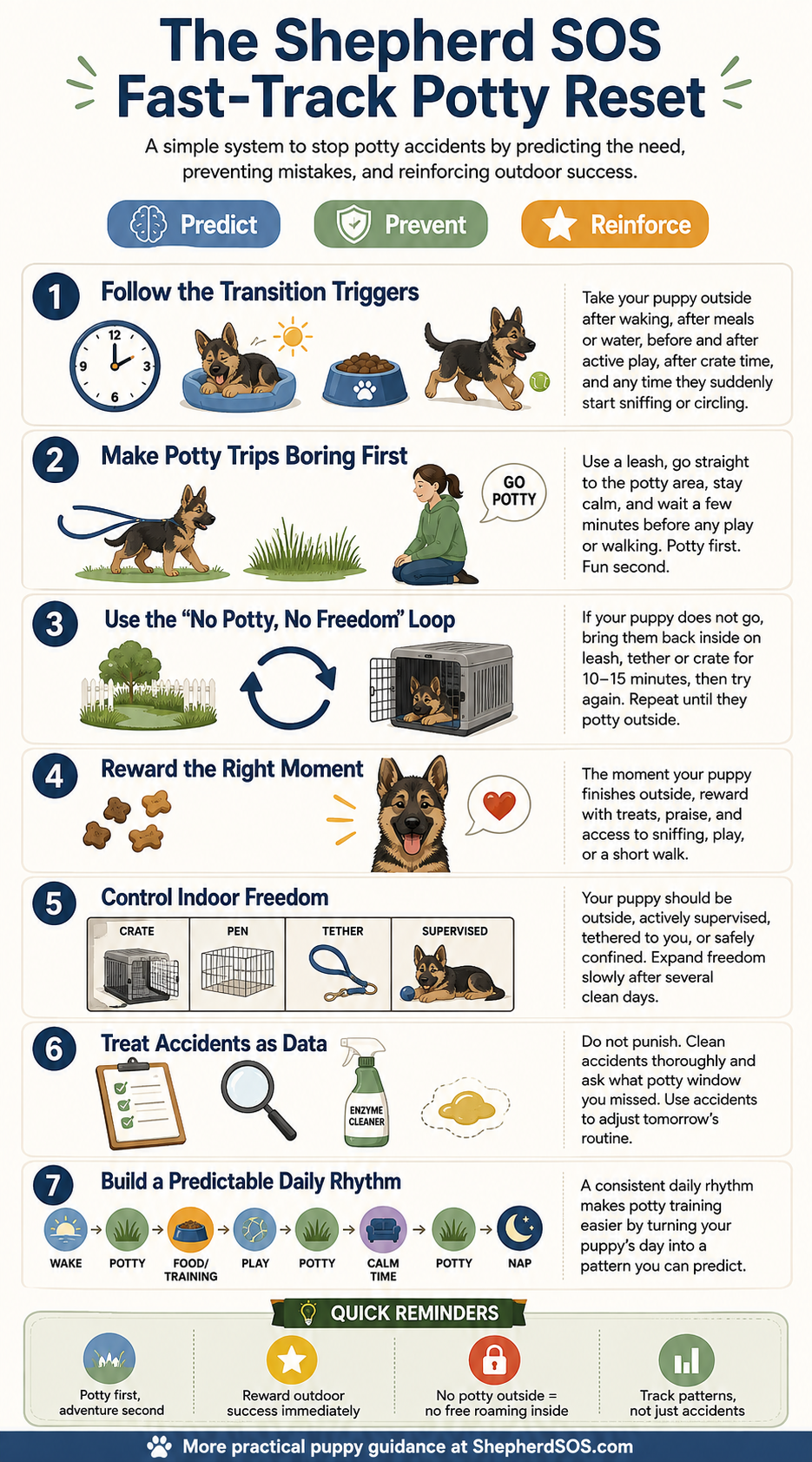
This reset is built on three actions:
Predict. Prevent. Reinforce.
Many owners see a major reduction in accidents within three to five days when supervision is consistent and thorough. However, that does not mean the puppy is fully house-trained in five days.
Dependable house training may take weeks or months, especially with very young puppies, inconsistent schedules, apartment living, digestive upset, previous pad training, or a long history of indoor accidents.
What You Need
An enzymatic cleaner: Accidents are going to happen. These products help break down the stains and odors in carpet that can draw a puppy back to the same location.
6-foot leash: Use it for focused potty trips, walks, and supervised indoor tethering.
High-value rewards: Shepherd puppies love training treats like beef liver. Reserve treats and dry kibble in a dog treat pouch for successful outdoor elimination.
A crate, pen, or gated puppy zone: The area should be safe, comfortable, and appropriately sized. Never use confinement as punishment.
A potty tracker: Record meals, water, naps, play, urination, bowel movements, and accidents. Patterns that feel random often become obvious after two or three days.
Step 1: Follow the Transition-Trigger Rule
Most preventable accidents occur after a change in physical or emotional state.
Take your puppy directly outside:
Immediately after waking
Shortly after meals or a long drink of water
Before and after active play
After training or exciting greetings
Before entering and after leaving the crate
Before bedtime
Whenever the puppy suddenly disengages and begins sniffing the floor, a.k.a. the “Sniff-and-Circle”
Do not think only in terms of the clock. Think in terms of transitions.
Wake up? Outside.
Big drink? Outside.
Wild play session? Outside.
An unnecessary potty trip is better than another rehearsed accident.
Carry a very young puppy from the crate to the exit when needed. The immediate goal is to reach the potty area before the bladder empties halfway across the room.
Step 2: Make the Potty Trip Boring—At First
Clip on the leash and walk directly to the same small potty area. Give the puppy enough room to sniff and turn, but not enough freedom to explore the entire yard.
Use one calm cue, such as “Go potty,” and then remain quiet.
Give the puppy about five minutes. Avoid giving attention, playing, or beginning a walk before elimination.
If outdoor fun always comes first, your puppy may learn that pottying ends the adventure and begin holding it.
Once the puppy eliminates, the environment opens up:
Treats
Praise
Sniffing
Play
A short walk
The puppy begins learning that eliminating outside does not end the fun. It unlocks it.
Step 3: Use the “No Potty, No Freedom” Loop
When the puppy does not eliminate, do not release it from the leash when you re-enter the house.
Instead:
Bring the puppy inside on leash.
Place them in the crate for 10 to 15 minutes, or keep them tethered to you.
Do not begin play.
Return to the designated potty area.
Repeat until the puppy eliminates.
This is not punishment. It is management.
Once they potty outside, reward them and provide supervised freedom.
Step 4: Reward at the Right Moment
Timing determines what your puppy thinks they earned.
Reward within one or two seconds after the puppy finishes—not after returning to the kitchen.
If food arrives indoors, your puppy may associate it with coming inside rather than eliminating outside. For every successful elimination, immediately offer a small jackpot:
Three or four tiny treats in sequence
Genuine praise
Permission to sniff and explore
A brief game with their favorite toy
For many Shepherd puppies, movement is a powerful reward. Pottying can become the behavior that unlocks the yard, walk, or 60-second tug game.
Step 5: Control Indoor Freedom
During the fast-track potty reset, your puppy should be:
Outside on a purposeful potty trip
Actively supervised within arm’s reach
Tethered to an adult
Safely confined in a crate, pen, or puppy-proofed area
“Supervised” does not mean the puppy is somewhere in the room while you’re scrolling on your phone, answering work calls or emails, cooking dinner, or watching TV.
It means you can act when the first “sniff-and-circle” sequence begins.
After several accident-free days, open one additional small area while supervising. If accidents return, reduce freedom again without anger or frustration.
Step 6: Handle Accidents Without Creating Fear
If you catch your puppy beginning to eliminate:
Calmly interrupt with a neutral sound
Take the puppy outside immediately
Reward outdoor completion
Do not yell, chase, loom over, or frighten the puppy.
If you discover the accident afterward, say nothing to your puppy. Clean the area thoroughly with enzymatic spray and adjust your management plan.
Ask yourself:
Which transition did I miss?
Was the puppy unsupervised?
Did they fail to potty on the previous trip?
Was play unusually intense?
Is the interval between breaks too long?
Could there be a medical problem?
The accident is data. Use it.
This shift in perspective is important. Instead of viewing the accident as defiance, treat it as evidence that the current routine contains a gap somewhere.
Step 7: Build a Predictable Daily Rhythm
Potty training becomes easier when the puppy’s entire day has structure.
A simple cycle looks like this:
Wake → potty → food or training → play or enrichment → potty → calm activity → potty → nap
This cycle works well for high-drive Shepherd puppies because it prevents long, chaotic periods of stimulation while pairing activity with predictable bathroom opportunities.
It also supports the broader Shepherd SOS principle that behavior improves when a puppy receives the right balance of:
Activity
Mental engagement
Environmental exposure
Decompression
Sleep
Nervous-system recovery
Do not withhold normal water access merely to prevent accidents. Puppies need appropriate hydration.
Instead, monitor drinking, take the puppy out afterward, and contact your veterinarian if thirst or urination suddenly increases.
Common Shepherd Puppy Potty Problems
“My Puppy Pees on the Same Rug Every Time”
Remove the rug temporarily and clean the area with enzymatic spray, following the directions. Inspect the carpet padding if urine has soaked through.
Soft surfaces can become a learned toilet preference. Removing access prevents more practice while the outdoor habit becomes stronger.
“My Puppy Pees Immediately After Coming Inside”
The puppy was probably distracted, did not fully empty, or learned that elimination ends outdoor time.
Use the no-potty, no-freedom loop.
After the puppy urinates, wait quietly for another minute in case they need a second opportunity. Then reward them and begin the fun portion of the outing.
“My Puppy Gives No Warning”
The warning may be much more subtle than you expect.
Watch for:
Stopping suddenly during play
Intense floor sniffing
Circling
Returning to an old accident area
Becoming restless in the crate
Briefly looking toward the exit
Do not rely on these signals alone. Tighten the schedule and continue taking the puppy out proactively.
“My Trained Puppy Suddenly Has Accidents Again”
Sudden regression can sometimes have a medical cause. It especially deserves medical attention when accompanied by:
Frequent attempts to urinate
Small amounts of urine
Straining or discomfort
Blood in the urine
A strong or unusual odor
Excessive genital licking
Unusual thirst
Leakage during sleep or rest
Urinary tract infections, bladder stones, inflammation, medication side effects, metabolic disease, digestive problems, and other conditions can contribute to house soiling.
Contact your veterinarian if your puppy is experiencing any of the symptoms listed above.
Frequently Asked Questions
How Long Can a Shepherd Puppy Hold Their Bladder?
The “one hour per month of age” guideline is a rough estimate, not a guaranteed schedule.
A three-month-old puppy may sometimes last three hours while resting but need to urinate much sooner after waking, drinking, eating, training, or playing.
Build the schedule around your puppy’s real patterns rather than pushing them toward a theoretical maximum.
Should I Use Puppy Pads?
For an outdoor-only goal, pads can create an extra transition because they teach elimination on an indoor surface. Whenever practical, take the puppy directly outside.
Pads can still be useful in certain situations, including:
High-rise apartment living
Owner mobility limitations
Veterinary restrictions
Unsafe weather conditions
A young puppy lacking access to a sanitary outdoor area
When pads are necessary, use one deliberate location and create a gradual transition plan rather than scattering pads throughout the home.
Should I Wake My Puppy During the Night?
Very young puppies may need nighttime potty trips.
Keep them quiet and businesslike: take the puppy to the potty area, reward calmly, and return to bed. Do not turn the trip into a play session.
Track when your puppy wakes or has accidents. Gradually extend the interval as their body matures, and they demonstrate that they can remain clean longer.
Should I Teach My Puppy to Ring a Bell?
A bell can help your puppy communicate, but it does not replace a proactive potty schedule.
Some intelligent Shepherd puppies quickly learn that ringing the bell opens the door—even when they only want to chase leaves, patrol the yard, or look for entertainment.
Reward actual outdoor elimination, not simply the bell ring, and continue supervising until house training is reliable.
How Do I Know When My Puppy Is Fully House-Trained?
Look for:
Several consecutive weeks without accidents
Consistent elimination in the correct outdoor area
Clean crate or confinement periods
The ability to remain clean during normal daily intervals
A dependable signal when an unexpected need arises (i.e., sitting in front of the door patiently)
Temporary setbacks can still happen during illness, digestive changes, travel, adolescence, household stress, schedule disruptions, or moves to unfamiliar environments.
A setback does not mean all previous training has disappeared. Return to tighter management, rebuild the routine, and rule out health problems when appropriate.
The Real Fast Track Is Structure
The fastest way to stop Shepherd puppy potty accidents is not to demand more from an immature puppy.
It is to remove opportunities to fail.
Predict the transitions.
Prevent unsupervised wandering.
Make potty trips clear and focused.
Reward immediately.
Track the pattern.
Expand freedom slowly.
And treat every accident as information—not defiance.
Your puppy is not trying to ruin the rug. They are learning a household rule that only becomes clear through consistent repetition.
When the environment is structured correctly, the right behavior becomes easier, the wrong behavior becomes harder, and both of you can finally stop living from puddle to puddle.
Next Step: Turn Guesswork Into a Pattern
Download the free Shepherd Puppy Potty Tracker & Timeline to record your puppy's
Meals
Water intake
Naps
Play sessions
Training sessions
Potty trips
Accidents
The tracker pairs extremely well with our Puppy Schedule Generator, which you can use to build your daily routine around the potty triggers in this guide.
👇 Fill out the form below to get immediate access to both.
Want the Routine Built Specifically Around Your Puppy?
If you want to do this yourself, then this guide gives you plenty to start with.
But if accidents are only one part of the problem—perhaps your puppy is also biting, screaming in the crate, struggling to settle, pulling on the leash, guarding resources, or turning evenings into chaos—you may not need more generic tips.
You may need someone to look at the whole picture.
During a Shepherd SOS Consult Call, we review your puppy’s age, routine, environment, sleep, activity, management, and behavior patterns to identify where the system is breaking down and build a practical plan for your real household.
Instead of spending weeks trying random adjustments and wondering which one matters, you leave with clearer priorities and a structure you can actually follow.
Click here to learn more or book a Shepherd SOS Consult Call now.
Recommended Articles


Stop Shepherd leash pulling, lunging, and leash biting with a practical, reward-based plan for calmer walks, better focus, and safer handling.