
How to Stop Shepherd Puppy Biting: The “Land Shark” Survival Guide
A practical, punishment-free plan for German Shepherds, Belgian Malinois, shepherd mixes, and other high-drive puppies
Table of Contents
Your new puppy looked soft, sweet, and innocent in the photos. Then they came home and declared war on your hands, ankles, sleeves, shoelaces, and every pair of pants you own.
Welcome to the land shark phase.
If you are searching for how to stop a German Shepherd puppy from biting, understand this first: you probably do not have a “bad” puppy. You have a young dog with sharp teeth, poor impulse control, and almost no idea what humans consider appropriate play.
For shepherd breeds and shepherd mixes, the behavior can feel especially intense.
Movement is exciting. Fast feet invite pursuit. Loose clothing becomes a tug toy. Children sound and move like playmates. Add teething discomfort, overstimulation, and too little sleep, and your cuddly puppy can become a four-legged house destroyer.
The goal is not to punish your puppy for using their mouth. It is to teach them that human skin and clothing make play stop, while toys, chews, calm behavior, and appropriate games keep good things happening.
That is the Shepherd SOS approach: spot the pattern, stop the rehearsal, build structure, teach the replacement, and track the result.
What Is the Land Shark Phase?
Puppy mouthing, nipping, and play biting are normal developmental behaviors. Puppies use their mouths to investigate objects, invite play, communicate, and learn how much pressure is too much.
Teething adds another reason to chew. Most puppies begin losing baby teeth at roughly three to four months, with adult teeth generally arriving around six months. However, movement, fatigue, frustration, and overarousal are often bigger drivers of biting habits.
German Shepherds, Belgian Malinois, Dutch Shepherds, and other working-breed dogs were developed to notice and influence movement. In a home, that sensitivity can become ankle chasing, pant-leg grabbing, or attempts to control running children.
It is usually not a calculated act of dominance. Movement has simply activated a rewarding behavior pattern and habit.
Normal behavior, however, does not mean it’s harmless. Every successful chase, squeal, sleeve tug, or wrestling match can strengthen the habit.
Shepherd SOS focuses on preventing that rehearsal instead of waiting for the puppy to “grow out of it.”
First, Identify Why Your Puppy Is Biting
“Puppy biting” can describe several different situations. Look at what happens immediately before it.
Play or movement: The puppy is loose and bouncy or targets ankles, clothes, and feet when someone moves.
Teething: They gnaw on toys, furniture, crate bars, and household objects, often seeking firm or cool surfaces.
Overstimulation or fatigue: They become frantic, rough, loud, and difficult to redirect after intense activity or too much time awake. Predictable naps can help prevent overtired puppy biting.
Frustration: They bite when restrained, denied access, or asked to stop an activity. They have not yet learned how to tolerate disappointment.
Pain, fear, or handling sensitivity: They stiffen, freeze, guard an item, growl when touched, or react suddenly when picked up. This is not a routine land shark moment. Pain and medical problems can contribute to behavioral changes, so a veterinary examination may be appropriate.
Once you know the pattern, you can stop guessing and choose the right response.
Why Common Puppy-Biting Advice Often Fails
Yelping may increase excitement
Some puppies pause at a yelp; others become more aroused. If “ouch” makes your puppy bite harder, stop using it.
Pulling away creates a game
Jerking your hand, waving your arms, or kicking your feet away can make the target more interesting to a shepherd puppy. A moving sleeve behaves like a tug toy. A retreating ankle becomes something to catch.
Speaking of games, our Free Shepherd Puppy Land Shark Toolkit gives you 12 Mental Enrichment Training Games to help reduce biting, build focus, and develop a calmer puppy. Fill out the form below to get immediate access. ⬇️
Repeating “no” teaches no replacement
Repeatedly saying “no” does not tell the puppy whether to sit, release, take a toy, or settle. An interruption is useful only when it leads to a behavior they can perform.
Physical punishment can create bigger problems
Holding the muzzle shut, pinning the puppy, scruffing, hitting, or using painful corrections may suppress behavior briefly without teaching a safer choice.
You do not need to overpower a shepherd puppy. You need to make the correct behavior clear, easy, and rewarding.
Prepare the Environment Before Training
Keep long tug toys, appropriate chews, food toys, baby gates, a playpen, and treats within easy reach. Match every chew to your puppy’s size and chewing strength, supervise its use, and discard damaged pieces.
A lightweight house line can help you guide the puppy away from children, furniture, or clothing without grabbing its collar. Use it only under direct supervision and never inside a crate because it can snag.
Create a calm recovery area—a crate, pen, puppy-proof room, mat, or bed—that predicts decompression and sleep rather than punishment.
The Shepherd SOS Step-by-Step Plan
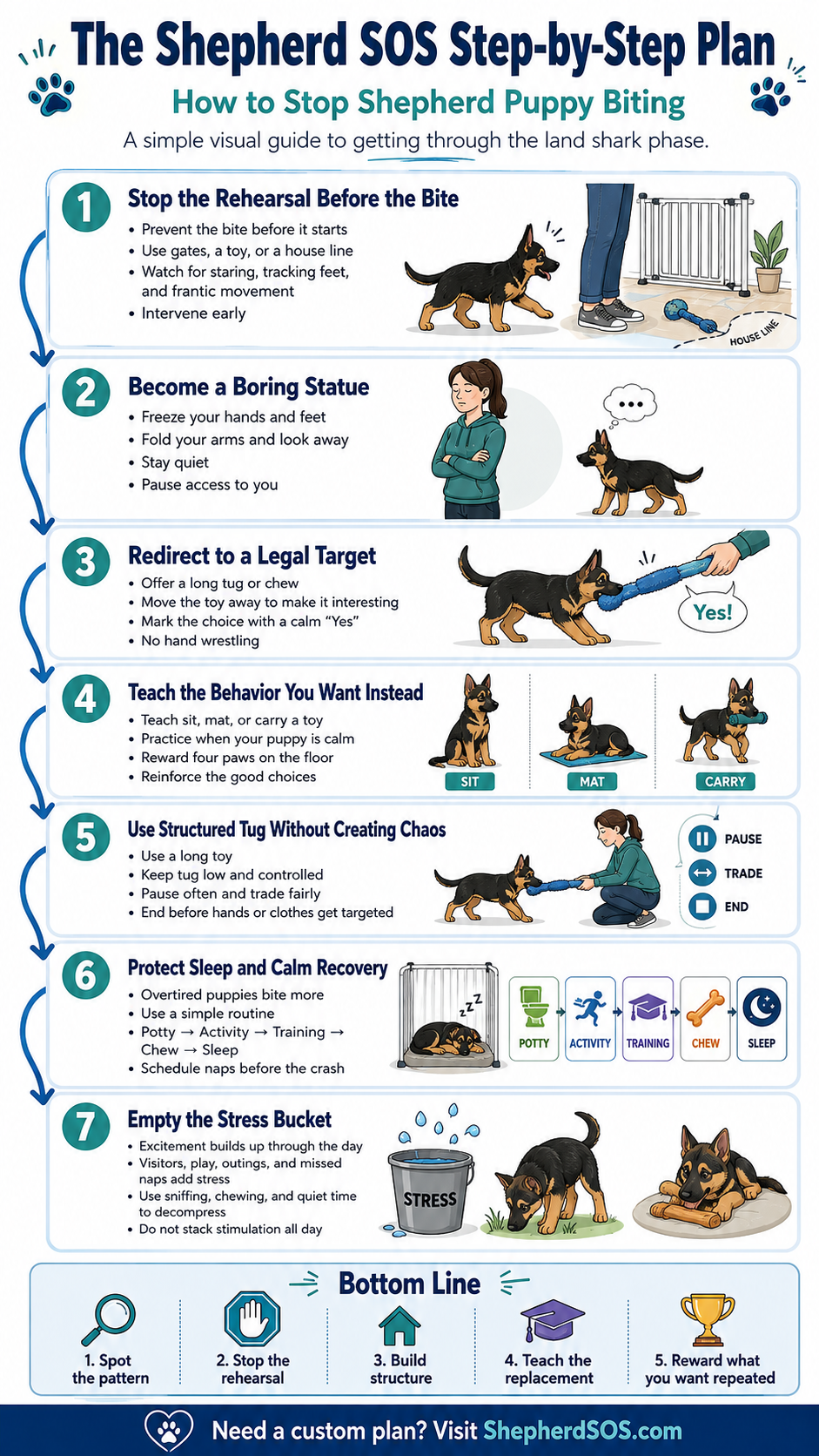
Step 1: Stop the Rehearsal Before the Bite
The easiest bite to address is the one that never happens.
Use gates when children are running. Put the puppy behind a barrier before guests become exciting. Carry a toy during the predictable biting hour. Use a supervised house line during active family time.
Watch for early signs:
Tracking feet
Staring at clothing
Grabbing the leash
Frantic movement
Jumping repeatedly
Suddenly ignoring familiar cues
Intervene early. Waiting until the puppy is hanging from your sweatshirt makes learning much harder.
Management is not avoiding training. It creates enough control for training to work.
Step 2: Become a Boring Statue
When teeth touch skin or clothing, remove the reward immediately.
Freeze your hands and feet. Fold your arms close to your body. Look away and stay quiet.
When the puppy disengages, redirect them calmly or step behind a gate for 10 to 30 seconds.
Biting people makes access to people pause.
If the puppy keeps jumping and biting, do not remain there while they rehearse. Step behind a barrier or calmly guide them to a safe reset area.
Step 3: Redirect to a Legal Target
A toy lying motionless on the floor is rarely more exciting than a moving human. Make it worth choosing.
Drag a long fleece tug along the ground and move it away from the puppy rather than pushing it into their face. Let them catch it, mark the correct choice with a calm “yes,” and continue playing while their teeth remain on the toy.
Timing matters. Redirection works best while the puppy can still think. Once they are wildly overstimulated, more toy movement may increase arousal. Switch to calm recovery instead.
Never use bare hands as toys. Rough hand wrestling practices the exact mouth-to-skin pattern you want to reduce.
Step 4: Teach the Behavior You Want Instead
“Stop biting” is not a complete training plan. Give your puppy an action that earns reinforcement.
Teach them to sit for attention, carry a toy when greeting people, go to a mat while children move, or walk beside you briefly.
Practice these behaviors when the puppy is calm—not only during a crisis.
Reward four paws on the floor, relaxed lying down, quiet observation, voluntary check-ins, and choosing a toy without being prompted.
The behavior you reinforce is the behavior most likely to return.
Step 5: Use Structured Tug Without Creating Chaos
Tug can be an excellent outlet for a German Shepherd or Malinois puppy when the game has rules.
Use a long toy. Keep it low and move it horizontally rather than wrenching the puppy’s neck. Pause frequently. Trade for food or a second toy instead of prying the puppy’s mouth open.
Restart when the puppy is composed, and end before they begin grabbing hands or clothing.
A thoughtful tug session teaches engagement, release, and recovery from excitement.
Step 6: Protect Sleep and Calm Recovery
One of the most overlooked solutions to extreme puppy biting is not more exercise.
It is more recovery.
High-drive puppies often look energetic when they are exhausted. Owners see zooming and biting, assume the puppy needs to be worn out, and add another walk or fetch session. The puppy becomes fitter, more aroused, and less able to settle.
Use a simple daily rhythm:
Potty → short activity → brief training or enrichment → calm chewing → sleep
Many young puppies benefit from a nap after approximately 45 to 90 minutes awake, but age, health, household activity, and the individual dog matter more than a rigid timer.
Track when your puppy becomes mouthy and schedule recovery before the usual crash.
A crate or pen can support sleep when introduced positively, but it should never become an angry punishment.
Step 7: Empty the Stress Bucket
Sometimes the final biting episode is only the last drop in a full stress bucket.
Poor sleep, visitors, busy outings, rough play, repeated handling, and missed naps all add arousal. By bedtime, something as small as walking across the room can trigger a full land shark explosion.
After exciting activities, schedule decompression: a quiet potty trip, sniffing, licking, chewing, lower household activity, and uninterrupted sleep.
Do not stack stimulation all day and expect perfect self-control at night.
Troubleshooting Common Puppy-Biting Problems
“My puppy bites my ankles when I walk.”
Carry a toy before moving. Reward one or two calm steps beside you, then release the puppy to sniff or play.
When ankle biting happens in the same place and at the same time every day, treat it as a routine problem. Use a gate, leash, toy, or scheduled nap before the pattern starts.
“My puppy ignores the toy and bites my hands.”
The toy may be too still, the puppy may be over threshold, or hands may have a longer reinforcement history.
Make the toy move away from the puppy. If they cannot switch targets, stop adding excitement and move to a calm reset.
“My puppy bites harder when I say no.”
Your voice may be adding attention or arousal. Use a predictable sequence instead:
Freeze → disengage → pause access → redirect when calm → reward the appropriate choice
“My puppy bites the leash.”
Avoid turning the leash into another tug toy. Stop moving, reduce how much loose leash is swinging, and cue a familiar behavior or scatter a few treats on the ground.
Continue walking when the puppy’s mouth is off the leash.
“My puppy targets the children.”
Use barriers, a leash, and direct adult supervision. Teach children to become still, fold their arms, and call an adult rather than correcting the puppy themselves.
Never leave a young child alone with a dog.
Running, yelling, and waving arms may make a shepherd puppy more likely to chase. Create calm, controlled interactions instead of allowing the puppy to practice treating children like littermates.
“My puppy bites during petting or handling.”
Pet briefly, pause, and see whether the puppy asks for more. Pair gentle handling with food and keep sessions short.
Stiffness, guarding, growling, sudden sensitivity, or repeated hard bites during handling warrant veterinary and professional guidance.
How Long Does It Take to Stop Shepherd Puppy Biting?
Many families see early improvement within one or two weeks after creating a consistent routine, preventing high-risk situations, protecting sleep, and removing the rewards that maintain biting.
Progress does not mean all mouthing disappears in 14 days. It means fewer episodes, softer bites, faster redirection, and quicker recovery.
Teething often improves around six months, but training and management determine whether mouthiness fades or becomes an adolescent habit.
Look for smaller wins: faster redirection, more voluntary toy choices, a shorter evening “witching hour,” and better settling after excitement.
Those are meaningful signs that your puppy is developing better emotional control.
When Puppy Biting Needs Professional Help
Seek veterinary or behavior support when bites repeatedly puncture skin, the puppy becomes tense before biting, the behavior occurs around food or stolen items, handling triggers hard bites, pain may be involved, or a child is being targeted.
Also get help if you are becoming afraid of your puppy.
Play biting is common. Fear, pain, guarding, and aggressive behavior require an individualized assessment.
Do not wait for a large shepherd puppy to become a powerful adolescent before getting help.
Frequently Asked Questions
When do German Shepherd puppies stop biting?
Mouthing often decreases as teething ends and impulse control develops, commonly around or after six months.
However, puppies do not automatically age out of every behavior they practice. Management, appropriate outlets, sleep, household consistency, and reinforcement shape adult behavior.
Should I use a spray bottle?
No. A spray bottle may interrupt the puppy temporarily, but it does not teach the correct response. It can also create fear, avoidance, or conflict around your hands.
Should I use a muzzle for puppy biting?
A muzzle is not a replacement for training.
Positive basket-muzzle conditioning can be a useful safety skill in appropriate cases, but putting one on a puppy simply to suppress normal play biting will not teach bite inhibition or emotional regulation.
Will more exercise stop the biting?
Not necessarily.
Appropriate physical activity matters, but endless high-arousal exercise can create a stronger, more excitable puppy. Balance movement with sniffing, short training sessions, food enrichment, chewing, calm observation, and sleep.
The goal is not merely to exhaust your puppy. It is to help them develop an off-switch.
Is my puppy trying to dominate me?
Usually not.
Puppy biting is more commonly connected to play, teething, movement, frustration, overstimulation, fatigue, fear, or discomfort.
A dominance label does not tell you why the behavior happened or what skill the puppy needs to learn.
The Bottom Line
You do not stop shepherd puppy biting by winning a physical battle.
You stop it by changing the pattern.
Spot what happens before the bite.
Stop the puppy from rehearsing it.
Build a routine that protects sleep and recovery.
Teach a clear replacement behavior.
Reward the choices you want repeated.
Track the results for seven days.
Your puppy is not giving you a preview of a doomed future. They are showing you the skills they have not learned yet.
With guidance, structure, and consistency, the puppy currently hanging from your sleeve can grow into the calm, confident, stable family dog you imagined.
Take the Next Step With Shepherd SOS
Want to keep your puppy busy? Access our free Shepherd Puppy Land Shark Toolkit to discover 12 mental enrichment training games to reduce biting, build focus, and develop a calmer puppy.
👇 Fill out the form below to get immediate access.
For individualized help, book a Shepherd SOS Consult Call with Coach Doug.
The virtual consultation includes a review of your puppy’s behavior and routine, clear training priorities, a customized 7–14 day action plan, and written follow-up—so you know exactly what to change first.
Recommended Articles


Stop Shepherd leash pulling, lunging, and leash biting with a practical, reward-based plan for calmer walks, better focus, and safer handling.