
How to Calm an Overstimulated Shepherd Puppy: Diffusing the “Gator” Phase
Table of Contents
One minute, your Shepherd puppy is playing nicely with a toy.
The next moment, their pupils widen, their ears stop responding to your voice, and they begin sprinting through the house like a small alligator with legs. They grab your sleeves, bite your hands, attack the leash, bark at furniture, and ricochet from one forbidden object to another.
You try asking for a sit. They bite harder. You offer another toy. They ignore it and launch themselves at your ankles.
You take them outside to “burn off the energy,” only to bring back an even more frantic puppy.
This sudden transformation is often called the "puppy witching hour," the "zoomies," or—among exhausted shepherd owners—the "gator phase."
Although the behavior can look aggressive or defiant, it is frequently a sign that your puppy has become overtired, overexcited, frustrated, or overwhelmed by more stimulation than their developing nervous system can handle.
Your puppy is not trying to give you a hard time. He/She is having a hard time settling.
Learning how to calm an overstimulated puppy is not about overpowering the behavior or demanding more obedience. It is about recognizing rising arousal, interrupting the pattern safely, and helping your puppy transition from frantic activity into genuine recovery.
For German Shepherds, Belgian Malinois, Dutch Shepherds, Australian Shepherds, Border Collies, livestock guardian mixes, and other high-energy working puppies, this skill can completely change daily life.
What Is Puppy Overstimulation?
Puppy overstimulation occurs when the demands of an experience exceed the puppy’s current ability to process and recover from it.
Every sound, smell, movement, person, dog, training exercise, car ride, game, and environmental change adds information for the puppy’s brain to process.
A well-rested puppy may handle that information successfully. A tired or already excited puppy may reach capacity quickly.
Once that happens, impulse control deteriorates.
The puppy may become:
Frantic or unusually fast
Unable to disengage from movement
Mouthier than usual
More vocal
Easily frustrated
Less responsive to familiar cues
Unable to settle despite appearing exhausted
This does not mean every burst of puppy energy is a problem. Puppy zoomies are common and may include brief running, spinning, play bows, and sudden changes of direction.
The difference is control and recovery.
Normal play typically contains pauses. Your puppy might sniff, shake off, change activities, look at you, or briefly lie down.
Overstimulated behavior tends to become faster, louder, harder, and increasingly difficult to interrupt.
Eventually, the puppy stops making thoughtful choices and simply reacts.
Why Shepherd Puppies Enter the “Gator” Phase So Easily
Shepherds and other working breeds were intentionally developed to notice movement, respond rapidly, persist through challenges, and remain engaged with their environment.
Those traits can make them intelligent and highly trainable, but they can also produce puppies that become intensely aroused by motion, novelty, frustration, and social interaction.
A shepherd puppy may become overloaded after:
Wrestling with another dog
Chasing children through the house
Playing several rounds of fetch
Attending a busy training class
Meeting multiple strangers
Exploring a crowded store
Spending too long in the yard
Missing a nap
Completing too many training repetitions
Experiencing several exciting events in the same day
This is why a puppy can know “sit,” “leave it,” or “place” perfectly at 10:00 a.m. and seemingly forget everything at 7:30 p.m.
The training did not disappear.
Their ability to access it did.
That distinction is essential to the Shepherd SOS approach: behavior is often the symptom. Before trying to correct the behavior, identify the dog’s state and what skill or support is missing.
Early Signs Of Puppy Overstimulation
The easiest gator episode to stop is the one that has not fully started.
Many owners notice only the final explosion because they have not yet learned the smaller signals that appear first. Your puppy may be approaching their limit when you see:
Faster, less coordinated movement
Repeated grabbing at clothing
Increasingly hard bites
Dilated pupils or an intense, fixed stare
Rapid panting unrelated to heat
Frantic barking or whining
Repeated jumping after previously settling
Inability to remain engaged with a toy
Difficulty taking treats gently
Leash biting or attacking the house line
Ignoring cues they normally understand
Moving from one unwanted behavior directly into another
Normal play usually includes pauses. The puppy may shake off, sniff the ground, change activities, return to the handler, or briefly lie down.
Overstimulated play often becomes tighter, faster, louder, and less flexible. The puppy stops making choices and begins reacting to everything.
Do not wait for the bites to become painful. Intervene when you first notice the loss of rhythm.
Why Common Advice Often Makes It Worse
“They Just Need More Exercise”
Sometimes they do.
But an already overstimulated puppy often needs less arousal, not more exhaustion.
Taking an already frantic puppy for a run, extending a fetch session, or encouraging another round of wrestling may increase arousal rather than resolve it.
An under-exercised puppy may need an appropriate outlet.
A puppy who is overstimulated needs help coming down.
Those are different problems.
Repeating Commands
Owners often respond to wild behavior with:
“Sit. Sit. Sit. No. Down. Leave it. Stop.”
This adds more sound, pressure, and frustration to an already overloaded interaction. When the puppy fails, the owner becomes louder, and the puppy becomes more frantic.
Once your puppy is redlining, stop testing obedience. Instead, start managing the environment.
Angry Crate Confinement
The crate can be an excellent place for sleep and decompression.
But angrily dragging a frantic puppy into it teaches a very different lesson.
Your reset should feel predictable and boring—not threatening.
You are not punishing your puppy.
You are helping them recover.
Chasing the Puppy
Chasing activates movement-seeking behavior and can transform an overstimulation episode into a highly reinforcing game.
Your puppy may not understand that you are trying to stop them.
They see a moving person, waving arms, loud noises, and an opportunity to run faster.
Management equipment and calm positioning work better than speed.
What You Need Before the Gator Phase Appears
Keep your calming tools prepared before the evening chaos begins:
A supervised house line: A lightweight leash the puppy can drag while supervised, allowing you to interrupt behavior without chasing. Remove it before crating or leaving the puppy unattended.
A quiet recovery area: This may be a covered crate, exercise pen, gated puppy room, or comfortable bed in a low-traffic space.
A safe food-stuffed toy or lick mat: Use soaked kibble, canned puppy food, plain canned pumpkin—NOT pumpkin pie filling—or another veterinarian-approved ingredient your puppy tolerates.
An appropriate chew: Select a puppy-safe option matched to your dog’s size and chewing style. Supervise chewing and remove any item that begins breaking into swallowable pieces.
A simple trigger log: Record when episodes happen, how long your puppy had been awake, and what occurred beforehand.
Many puppies begin softening within 10 to 20 minutes after stimulation is reduced, although full recovery may take longer with uninterrupted sleep.
Step-by-Step: How to Calm an Overstimulated Shepherd Puppy
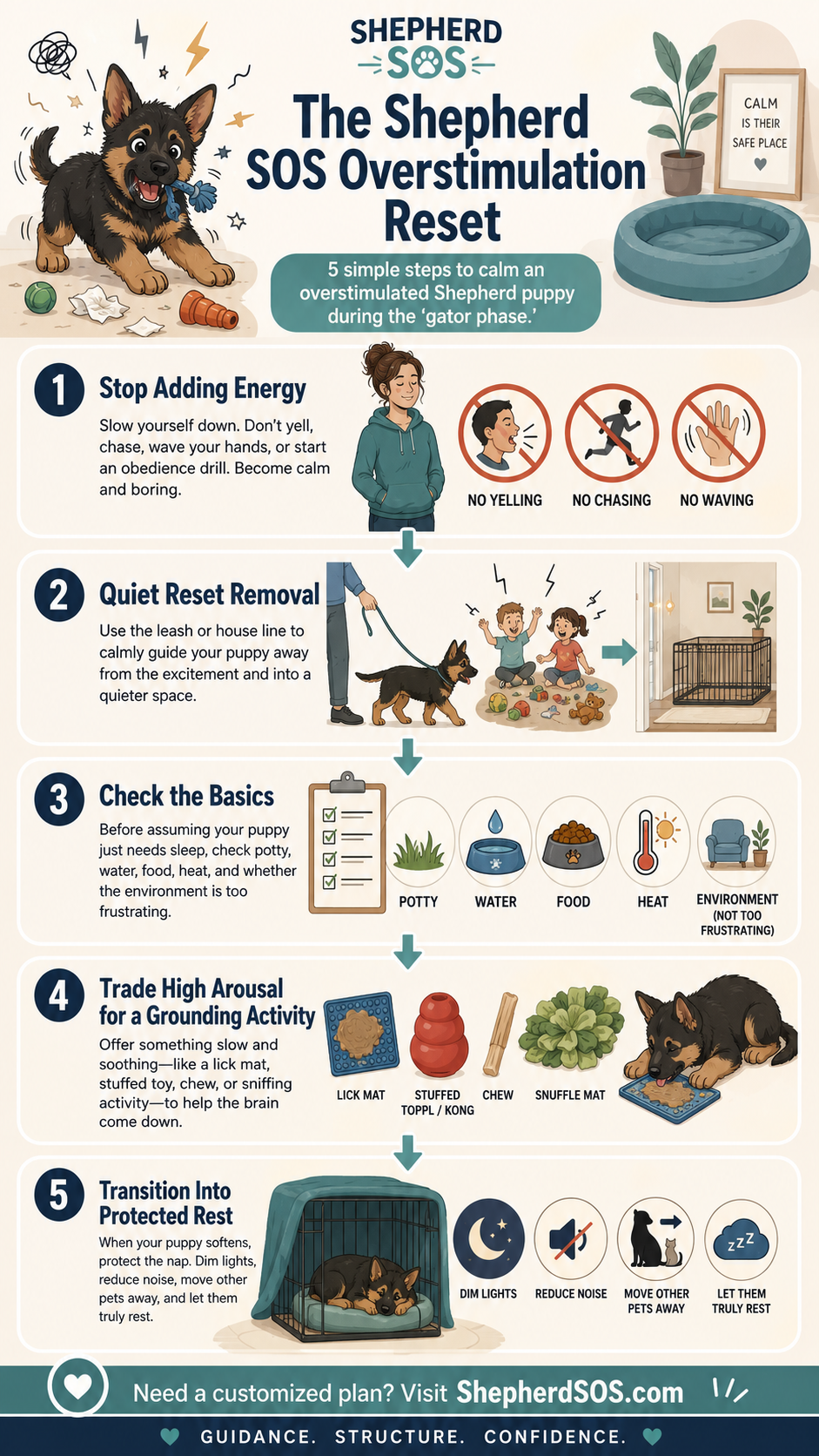
Step 1: Stop Adding Energy
The moment your puppy begins losing control, make your own behavior slower.
Do not yell.
Do not clap.
Do not grab at their face.
Do not begin a rapid obedience drill.
Plant your feet, turn slightly sideways, keep your hands close to your body, and minimize unnecessary movement. If the puppy is biting your clothes, avoid pulling the fabric back and forth. Tugging can make the interaction more exciting.
Your calm body language will not instantly hypnotize your puppy, but it prevents you from adding another layer of stimulation.
Step 2: Perform a Quiet Reset Removal
Use the supervised house line, leash, or a calm collar hold to guide your puppy away from the exciting environment.
Move them away from:
Children running or playing
Another dog
A busy living room
Visitors
Yard activity
Loud television
Repeated window triggers
Scattered toys
Anything else keeping them activated
Say as little as possible. A neutral transition phrase such as “reset time” is enough.
Move smoothly and deliberately. The removal is not a punishment. You are functioning as a circuit breaker until your puppy can regain control.
When children are involved, move the children to safety first rather than asking them to help manage the puppy. A highly aroused puppy should not be allowed to rehearse chasing, grabbing, or biting children.
Step 3: Check the Basic Needs
Before assuming your puppy needs sleep, quickly consider whether they need:
A potty break
Water
A meal
Relief from heat
Distance from another animal
A less painful or frustrating activity
Keep any potty trip boring and brief. Use a leash, give the puppy an opportunity to eliminate, and return indoors without beginning a new game.
If the puppy is panting heavily after exercise, appears disoriented, cannot cool down, vomits, collapses, or shows other signs of physical distress, treat the situation as a possible medical problem rather than ordinary overstimulation. Puppies can be more vulnerable to heat-related illness and require prompt veterinary attention when serious symptoms appear.
Step 4: Replace High Arousal With a Grounding Activity
You usually cannot take a puppy from frantic biting directly to complete stillness. Give the puppy an appropriate bridge activity.
Good options include:
Licking food from a mat
Working food from a stuffed rubber toy
Chewing an appropriate item
Sniffing scattered kibble in a towel or snuffle mat
Searching for several treats in a small, quiet area
Choose repetitive, low-intensity activities rather than tasks that demand speed.
This is not a time for difficult puzzle toys, excited praise, rapid tricks, fetch, flirt-pole play, or frustrating food dispensers. The activity should help the puppy slow down, not create another challenge to conquer.
Olfactory enrichment has been associated with reduced arousal-related behavior in dogs, although the exact effect depends on the individual dog and context.
If your puppy refuses food or immediately abandons the chew to attack the gate, leash, or your hands, they may be too far over threshold for active enrichment. Reduce visual and social stimulation further and give them space to recover.
Step 5: Transition Into Protected Rest
An overstimulated Shepherd puppy is often an overtired Shepherd puppy.
After several minutes of quiet licking, chewing, or sniffing, look for:
Slower breathing
Softer eyes
Less frantic movement
A hip rolled to one side
A lowered head
Reduced scanning
A deep sigh
Interest in lying down
At that point, transition into a nap or quiet rest period.
Young puppies often sleep 16 to 18 hours per day, and some may require even more depending on age, activity, and development. Regular quiet time is especially important for puppies whose biting intensifies when they are tired.
Create a sleep-supportive environment:
Dim the lights
Reduce household noise
Cover part of the crate if the puppy is comfortable with it
Move other pets away
Ask children not to disturb the puppy
Use white noise when appropriate
Keep the room comfortably cool
Avoid repeatedly checking on or talking to the puppy
Sleep also supports learning and memory processing in dogs, giving puppies another reason to receive genuine downtime after training and novel experiences.
A nap should be appropriate for the puppy’s age, potty needs, medical needs, and existing crate skills. If the puppy experiences severe confinement distress, use a pen or gated room and build crate comfort separately.
Preventing the Puppy Witching Hour
Emergency resets are useful, but prevention is the long-term solution.
Schedule Rest Before the Meltdown
If your puppy becomes wild at approximately 7:30 every evening, do not begin your calming routine at 7:35.
Begin it at 6:30 or 7:00.
Offer a potty break, a short sniffing activity, and then a protected nap before the usual biting window. Many evening gator episodes result from fatigue accumulating throughout the day.
Balance High- and Low-Arousal Activities
Not all enrichment affects the nervous system in the same way.
Higher-arousal activities may include:
Fetch
Wrestling
Flirt-pole play
Chasing
Fast obedience drills
Busy public outings
Intense dog play
Lower-arousal activities may include:
Sniff walks
Scatter feeding
Slow food searches
Calm chewing
Licking
Mat work
Gentle handling
Quiet observation from a distance
Your puppy does not need a life without excitement. They need recovery between exciting experiences.
Follow a stimulating activity with something slower rather than stacking one intense event on top of another.
Keep Training Sessions Short
A five-minute session that ends successfully is more valuable than a 20-minute session that ends with leash biting and frustration.
For young puppies, use brief repetitions, frequent reinforcement, and clear stopping points. Finish while the puppy can still think.
Training should build regulation, not test how long the puppy can endure pressure.
Protect Undisturbed Sleep
Give your puppy a quiet resting place where people and pets leave them alone. The RSPCA recommends providing puppies with a comfortable, quiet area where they can rest without being disturbed.
A puppy who wakes every time someone walks through the room may spend hours lying down without receiving enough restorative sleep.
Troubleshooting Common Problems
“My Puppy Runs Away When I Try to Catch Them”
Do not chase.
Step on the supervised house line, calmly block access with a gate, or walk into a smaller puppy-safe area. Practice gentle collar handling and leash pickups during calm periods so those actions do not always predict the end of fun.
“My Puppy Attacks Me During the Reset”
Use barriers rather than your hands.
Step behind a baby gate, guide the puppy into a pen, or use the leash to create safe distance. Avoid holding a frantic puppy against your body unless immediate safety requires it.
Persistent, intense, or injurious biting deserves individualized professional guidance.
“The Crate Makes Everything Worse”
Do not force a panicking puppy to remain in a crate solely because they are overstimulated.
Use a larger pen, gated room, or another safe resting area while you rebuild positive crate associations. Severe confinement distress differs from a puppy briefly protesting because they would rather keep playing.
“My Puppy Wakes Up and Immediately Becomes Wild Again”
Check whether the puppy actually slept. A puppy who spent 30 minutes barking, chewing the crate bars, or watching household activity did not receive a restorative nap.
Also review whether hunger, discomfort, insufficient potty opportunities, pain, or an overly chaotic environment is interfering with rest.
Frequently Asked Questions
How Can I Tell the Difference Between Normal Play and Overstimulation?
Normal play contains pauses, role changes, loose body language, and opportunities to disengage. The puppy can usually respond to their name, take food, switch toys, or briefly settle.
Overstimulated behavior becomes repetitive and difficult to interrupt. Movement becomes frantic, bites become harder, and the puppy appears unable to stop even when they are visibly tired.
Does Mental Stimulation Cause Overstimulation?
It can.
Mental enrichment is valuable, but more is not automatically better. Long training sessions, difficult puzzles, repeated frustration, and constant novelty can exhaust a puppy’s coping ability.
Use enrichment that matches the puppy’s current state. A rested puppy may enjoy problem-solving. A redlined puppy may need simple sniffing, licking, chewing, or sleep.
Should I Ignore an Overstimulated Puppy?
Do not reward demand behavior with exciting attention, but do not ignore safety.
Quietly interrupt biting, prevent access to children or other pets, reduce stimulation, and help the puppy reach an appropriate recovery space.
Is Overstimulation the Same as Aggression?
Not necessarily.
Overarousal can produce intense mouthing, barking, grabbing, and redirected biting without indicating an established aggression problem. However, behavior should not automatically be dismissed as “just overstimulation.”
Seek veterinary and qualified behavioral support when episodes are severe, unpredictable, worsening, associated with guarding or fear, causing puncture wounds, or accompanied by freezing, prolonged stiffness, disorientation, pain, or sudden personality changes.
Build the Off-Switch Before You Need It
Calming an overstimulated Shepherd puppy is not about finding a magic command that shuts down chaos.
It is a daily system.
You learn your puppy’s early warning signs. You interrupt the pattern before they lose control. You balance movement with decompression, novelty with familiarity, training with recovery, and freedom with structure.
Most importantly, you stop measuring success by how exhausted you can make your puppy.
A stable working dog is not created through nonstop activity. Stability develops when the puppy learns how to move through excitement and return to a regulated state.
That off switch begins with your routine.
Next Steps
Use our Free Puppy Schedule Generator to create a practical routine of physical activity, mental enrichment, potty breaks, structured freedom, and protected sleep with a click or tap of a button!
👇 Fill out the form below to get immediate access.
When generic schedules and internet advice aren't enough, the Shepherd SOS Consult Call looks beyond the single behavior to identify the routine, arousal patterns, environmental triggers, missing skills, and management changes contributing to the problem.
Instead of trying another generic puppy schedule or piecing together contradictory advice, you can get a practical plan built around your puppy, your household, your schedule, and the behavior you are actually dealing with.
Your puppy does not need more chaos disguised as exercise.
They need guidance, structure, and the opportunity to recover.
Click here to learn more or book a Shepherd SOS Call now.
Recommended Articles


Stop Shepherd leash pulling, lunging, and leash biting with a practical, reward-based plan for calmer walks, better focus, and safer handling.