
How to Stop Shepherd Puppy Alert Barking: Fixing Window and Yard Reactivity
Table of Contents
Your shepherd puppy freezes mid-step.
Their ears shoot forward. Their body stiffens. Then the explosion begins.
A neighbor walks past the window, a delivery truck stops outside, or a dog barks three houses away—and suddenly your living room becomes a high-alert command center.
At first, the behavior may have seemed harmless or even impressive.
“They’re already protecting the house.”
But repeated Shepherd puppy alert barking can quickly turn into chronic window reactivity, fence running, door charging, restless pacing, and an inability to relax inside the home.
What begins as two warning barks can become a rehearsed daily job that keeps your puppy’s nervous system activated for hours.
The goal is not to eliminate every bark.
Barking is normal canine communication, and many shepherds are naturally attentive to environmental changes. The goal is to teach your puppy that they do not have to investigate, control, or chase away everything they see and hear.
Using the Shepherd SOS approach, you will:
Predict the trigger. Prevent the rehearsal. Reinforce a calmer response.
Instead of reacting to the environment with a scream, your puppy can learn to notice a sound, check in with you, and return to a calmer activity.
What Is Shepherd Puppy Alert Barking?
Alert barking is your puppy’s way of announcing that something in the environment has changed.
A person approached the house.
A car door closed.
A dog appeared across the street.
Someone stepped onto the porch.
Shepherds and other working breeds are often exceptionally observant. They notice motion, sound, scent, and changes in familiar patterns that many other dogs ignore. However, not every barking episode is driven by a confident desire to “protect” the home.
Alert barking can also involve:
Uncertainty about unfamiliar people or sounds
Fear of something the puppy does not understand
Frustration caused by a window, fence, leash, or door
Excitement and social arousal
Boredom and self-created stimulation
A learned habit that has been repeatedly reinforced
General stress from insufficient sleep or excessive stimulation
A puppy barking behind a window may look bold, but the barrier can make them feel trapped, frustrated, or unable to gather more information. Veterinary behavior guidance recognizes that territorial displays can intensify when a dog is confined behind a window, door, fence, or other barrier.
That is why the best solution is not simply correcting the noise. You must understand the emotion and pattern producing it.
Alert Barking, Demand Barking, and Reactivity Are Not the Same
These behaviors can sound similar, but they require slightly different solutions.
Alert barking
The puppy reacts to a change in the environment, such as a person walking past the house or a noise outside.
Demand barking
The puppy barks directly at you because they want something—food, play, attention, access to the yard, or help reaching a toy.
Reactive barking
The puppy has a larger emotional response that may include lunging, growling, whining, spinning, pulling, or struggling to disengage from the trigger.
A Shepherd puppy can display all three behaviors, sometimes within the same day.
For example, your puppy may alert bark at a neighbor, become reactive when the neighbor’s dog approaches the fence, and then demand bark at you because you brought them inside.
Before beginning any training plan, identify what happens immediately before the barking and what your puppy gains from it. The sound may be the same, but the function can be different.
Why Window and Yard Barking Becomes Worse
Alert barking often becomes self-reinforcing.
Imagine that your puppy sees a mail carrier approaching the house. Your puppy barks, charges the window, and continues barking until the person leaves.
From your perspective, the mail carrier finished the delivery and walked away.
From your puppy’s perspective, the barking worked.
They sounded the alarm, confronted the intruder, and successfully made the person leave.
The next time someone approaches, your puppy may bark sooner, louder, and more intensely. The behavior becomes more efficient through repetition. Veterinary behavior resources note that when a dog barks or displays at an approaching stimulus and that stimulus retreats, the outcome can reinforce the response.
This is why allowing a Shepherd puppy to spend hours patrolling a front window rarely helps them “get used to” neighborhood activity. Some dogs habituate to repeated sights and sounds, but others become increasingly sensitized and reactive.
Every uncontrolled repetition strengthens the pathway you are trying to change.
Why Traditional Barking Advice Often Fails Working Breeds
Yelling “Quiet!” sounds like joining the alarm
Your puppy is already emotionally activated. When you rush toward the window and shout, you add more movement, volume, and urgency to the scene.
Your words may mean “stop” to you, but your tone and body language can communicate that the situation truly is an emergency.
Repeating the cue teaches your puppy to ignore it
“Quiet. Quiet. Quiet. I said quiet!”
A cue repeated during a full barking explosion becomes background noise. Your puppy is not calmly choosing to disobey. They may be too aroused to process familiar instructions.
A cue cannot replace environmental management.
Letting the puppy “bark it out” builds stamina
Barking does not always naturally extinguish when ignored, especially when it is directed at people, animals, and vehicles outside the home.
The trigger eventually disappears, which can reward the barking whether you respond or not.
Punishing the barking can worsen the underlying emotion
Shock collars, harsh leash corrections, shouting, and startling devices may suppress behavior temporarily without changing how the puppy feels about the trigger.
A puppy who already believes strangers or dogs are dangerous may begin to associate those triggers with additional discomfort. The American Veterinary Society of Animal Behavior recommends reward-based training and advises against aversive methods, including electronic collars and physical or psychological punishment.
Suppression is not the same as emotional stability.
Trying to train after the explosion begins
Once your puppy is barking, lunging, and ricocheting between windows, you are no longer working at the ideal learning point.
The most productive moment is often the second your puppy notices the trigger—but before the barking starts.
What You Need Before Training
You do not need an expensive collection of equipment. You need tools to control distance, visibility, timing, and reinforcement.
Frosted window film
Apply removable privacy film to the lower portion of the windows your puppy uses for patrol duty. The room can still receive natural light without giving your puppy an unrestricted view of every pedestrian, dog, bicycle, and delivery vehicle.
Baby gates or exercise pens
Use barriers to keep your puppy away from entryways and front windows during predictable high-traffic periods.
A leash or lightweight house line
A supervised house line allows you to guide your puppy away from a window without grabbing their collar or turning the moment into a physical confrontation.
Never leave a puppy unattended while dragging a leash.
High-value food
Use small pieces of chicken, hot dog, cheese, or freeze-dried meat. The reward must compete with the environment without upsetting your puppy’s stomach.
A marker word or clicker
A clear “Yes!” or click marks the exact moment your puppy makes the correct choice.
White noise
A fan, white-noise machine, or low-volume background audio can reduce the intensity of unpredictable outdoor sounds, especially during naps and overnight sleep.
A designated reset area
Choose a mat, bed, crate, gated room, or quiet area located away from the primary trigger zone. This gives your puppy somewhere specific to go after checking in.
How Long Does Alert Barking Training Take?
Many owners notice fewer barking explosions within one to two weeks once window access and unsupervised yard patrols are consistently managed.
That does not mean the behavior is permanently resolved in 14 days.
A puppy that has practiced window barking for months may need several weeks or more to develop a reliable replacement behavior. Progress also depends on:
How often does the puppy encounter triggers
How intensely they react
How long has the behavior been rehearsed
Whether the puppy can recover after barking
Household consistency
Sleep, exercise, and overall stress levels
Whether fear or aggression is involved
Measure progress by more than silence.
A puppy who still barks twice but disengages in five seconds is improving compared with a puppy who previously barked for five minutes.
The Shepherd SOS Alert-Barking Plan
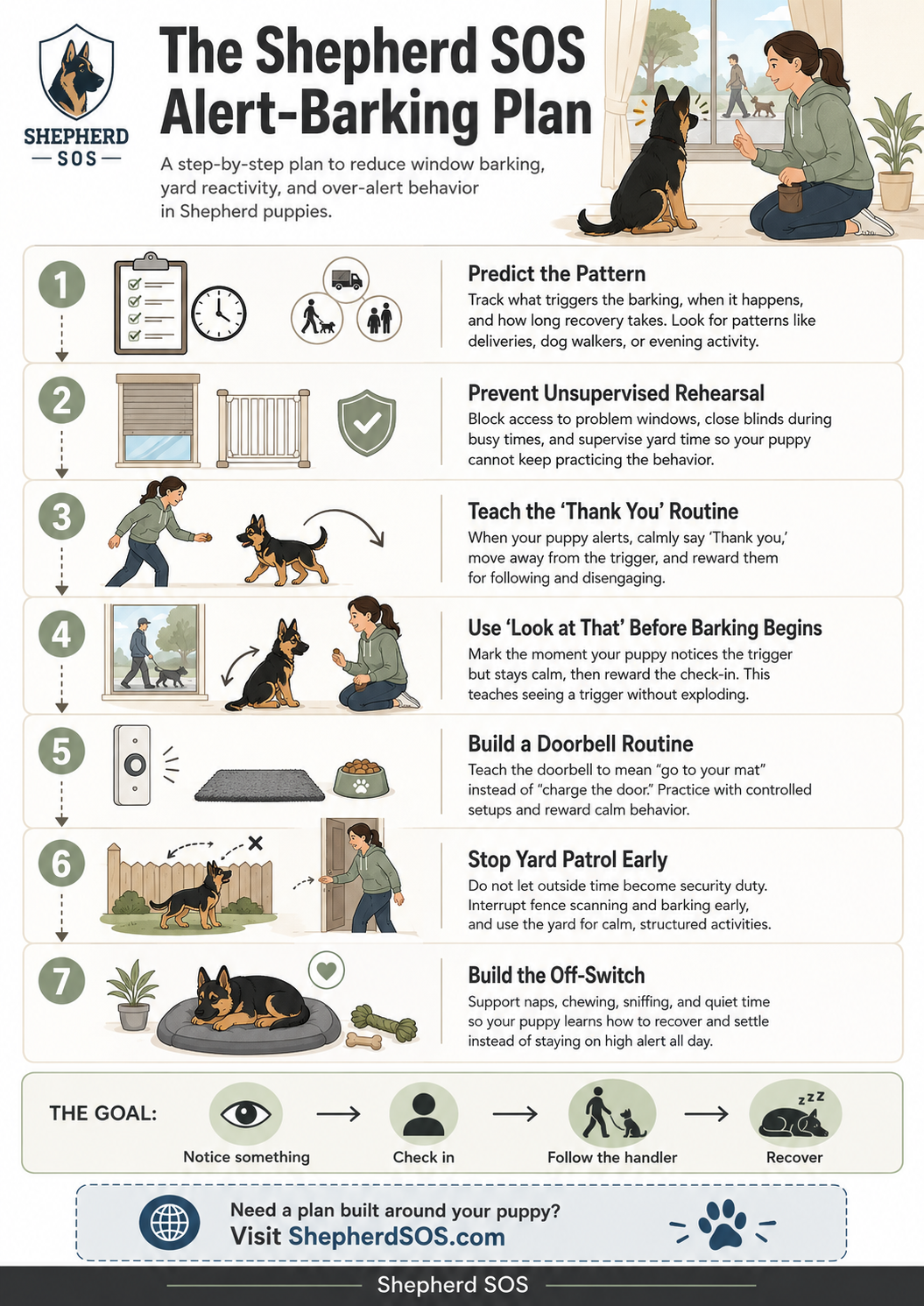
Step 1: Predict the Barking Pattern
For three days, record the most common barking episodes.
Write down:
What your puppy saw or heard
Where the puppy was standing
What time does it happen
How long does the barking continue
Whether the puppy accepted food
How quickly the puppy recovered
What happened immediately afterward
Patterns usually appear quickly.
You may discover that the barking is most intense during school dismissal, package delivery hours, evening dog walks, trash collection, or nighttime wildlife activity.
Once you can predict the trigger, you can prepare before the reaction.
The Shepherd SOS rule: Do not wait for chaos to begin before creating structure.
Step 2: Prevent Unsupervised Rehearsal
Environmental management does not avoid the problem. It is stopping your puppy from practicing the exact behavior you are trying to change.
Start by:
Covering the lower portion of street-facing windows
Closing blinds during busy neighborhood periods
Moving furniture away from windows
Blocking access to the front room
Keeping your puppy away from the door during deliveries
Bringing your puppy inside before fence running begins
Using white noise during naps and at night
Your puppy does not need unrestricted access to every window to become confident.
Confidence comes from experiencing triggers at an intensity they can process—not from being flooded by them all day.
Step 3: Teach the “Thank You” Disengagement Routine
Your puppy does not need to believe that something is wrong. They need to understand that their responsibility ends once they notify you.
Begin with mild, manageable triggers.
Your puppy notices a sound and gives one or two alert barks.
Calmly say, “Thank you.”
Move away from the window or door.
Encourage your puppy to follow.
Mark “Yes!” when they turn away from the trigger.
Reward them several feet away from the window.
Direct them to a mat, to chew, to scattered feed, or to another calming activity.
The reward is not for launching into a prolonged barking episode. It is for disengaging, following you, and becoming quiet.
As the behavior improves, begin marking earlier. The best repetition may be:
Hear the sousoftnd → look at you → move away → receive the reward.
Step 4: Use the “Look at That” (LAT) Pattern Before Barking Starts
The Look at That, or LAT, exercise changes what your puppy does after noticing a trigger.
Instead of:
See person → stare → stiffen → bark
You are building:
See person → mark → check in → receive reinforcement
Set up far enough from a partially covered window that your puppy can observe the environment without exploding.
The moment your puppy sees a person, dog, or vehicle:
Mark with “Yes!” or a click.
Feed beside your leg or slightly behind you.
Allow your puppy to look again.
Mark and reward another calm observation.
End after several successful repetitions.
You are not rewarding aggression. You are creating a new emotional and behavioral pattern around the trigger.
Keep sessions between three and five minutes. Stop while your puppy is still successful.
If your puppy cannot eat, respond to their name, or turn away, the setup is too difficult. Increase the distance, reduce visibility, or choose a milder trigger.
Step 5: Build a Doorbell Routine
The doorbell should become a cue for a predictable household routine—not the opening alarm of an invasion.
Choose a destination away from the front door, such as a cot or mat.
Practice without a visitor first:
Play a quiet doorbell sound.
Say, “Place” or “Mat.”
Guide your puppy to the mat.
Deliver several small treats.
Release them when the exercise is over.
Gradually increase the volume.
Next, have a family member ring the actual bell while you remain prepared with your puppy behind a gate or on a leash. Reward movement toward the mat, calm attention, and staying away from the doorway.
Don't start by asking your puppy to remain perfectly still while an unfamiliar visitor enters. Build the separate pieces before combining them.
Step 6: Stop Yard Patrol Before It Becomes Fence Reactivity
A yard is not automatically relaxing enrichment.
For some Shepherd puppies, unsupervised yard time becomes a shift at work. They scan the perimeter, listen for movement, race along the fence, and wait for something to confront them.
Go outside with your puppy and interrupt the patrol pattern early.
Bring them inside when you notice the following:
Repeated fence scanning
Stiff pacing
Running the same boundary line
Fixating on a neighboring yard
Ignoring familiar cues
Barking at sounds they cannot locate
Use the yard for specific activities:
Sniffing games
Short obedience sessions
Recall practice
Structured play
Food searches
Calm exploration
Supervised potty breaks
For dogs that react strongly at the fence, create more distance with an interior barrier, visual screen, garden fencing, or a long line used under direct supervision.
The objective is not to keep your puppy outside until they “deal with it.” The objective is to prevent repeated emotional explosions while building better skills.
Step 7: Build an Off-Switch Away From Triggers
Window and yard barking are often worse in puppies that never fully settle.
A puppy who spends the day cycling through rough play, patrol behavior, intense walks, training, and household activity may be physically tired but neurologically overactivated.
Schedule periods of intentional decompression:
Age-appropriate naps
Chewing or licking activities
Sniff-based enrichment
Quiet time behind a gate
Calm mat training
Low-stimulation walks
Predictable bedtime routines
Do not try to exhaust your puppy's alert barking with endless high-intensity exercise. More activity can create a fitter puppy who still does not know how to relax.
Your training plan must teach both sides of emotional control:
How to engage—and how to come back down.
A Simple Seven-Day Reset
Days 1–2: Stop the rehearsal
Cover problem windows, supervise yard access, block the front entryway, and begin tracking triggers.
Days 3–4: Teach disengagement
Practice the “Thank You” routine with softbe the following: sounds and low-level triggers. Reward turning away and following you.
Days 5–6: Introduce controlled exposure
Begin short “Look at That” sessions from a safe distance. End before your puppy becomes overwhelmed.
Day 7: Review the pattern
Compare your puppy’s barking duration, recovery time, and ability to eat or respond around triggers.
Do not judge progress only by the number of barks. Look for faster recovery and more voluntary check-ins.
Troubleshooting Common Alert-Barking Problems
“My puppy starts barking before I can reward them.”
Your setup is too difficult.
Increase the distance from the window, cover more of the view, lower the sound volume, or train during a quieter time.
The solution is not faster treat delivery during a meltdown. The solution is creating an easier learning opportunity.
“My puppy takes the treat and immediately runs back.”
Feed farther from the window and follow the reward with another activity.
Use a scatter of food, a mat routine, a chew, or a short sniffing exercise. One treat may interrupt the behavior without completing the transition.
“My puppy seems to bark, so I will give them food.”
This can happen when the sequence is always bark first, then treat.
Begin rewarding earlier moments:
Hearing a noise without barking
Looking toward you
Walking away from the window
Resting while neighborhood activity occurs
Choosing not to approach the door
The calmer choices should produce the highest payoff.
“My puppy barks at night when nothing is there.”
Your puppy may hear wildlife, distant doors, plumbing, heating systems, or building noises that you barely notice.
Use white noise, move the sleeping area away from exterior walls, and ensure your puppy is receiving adequate rest.
A sudden increase in nighttime barking may also warrant a veterinary check, particularly if accompanied by discomfort, restlessness, confusion, changes in hearing, or other unusual behavior. Animal welfare guidance recommends ruling out health problems when barking becomes excessive or changes unexpectedly.
“My puppy redirects onto me or another dog.”
Stop the session and create physical separation.
Redirected snapping, grabbing, or fighting indicates that the situation has moved beyond a simple barking problem. Do not reach into the puppy’s collar or physically wrestle them away from the trigger.
Use gates, barriers, leashes, and professional guidance to protect everyone involved.
Frequently Asked Questions
Is alert barking a sign of aggression?
Not necessarily.
Young puppies may bark because of surprise, uncertainty, frustration, excitement, or incomplete socialization. Look at the whole body, not just the noise.
Repeated lunging, hard staring, growling, snapping, redirected biting, or an inability to recover deserves professional attention. Alert barking can become part of a larger territorial pattern when it is repeatedly rehearsed and intensified.
Should I let my shepherd puppy watch out the window to socialize them?
Controlled observation can be useful. Unrestricted patrol duty is not.
A puppy calmly observing its surroundings for a few minutes while responding to you is very different from a puppy spending hours scanning, stalking, and exploding at movement.
Socialization is not passive exposure to everything. It is helping the puppy experience the world at an intensity that supports curiosity, recovery, and learning.
Should I teach “speak” before teaching “quiet”?
You can, but it is not required.
For most window-reactivity cases, environmental management, disengagement, mat training, and reinforcement of calm behavior are more important than cueing the barking itself.
Will my puppy stop protecting the home?
Teaching emotional control does not erase awareness.
Your puppy can still notice unusual activity and alert you. The difference is that they learn to hand responsibility back to the handler instead of escalating for several minutes.
A stable dog can notice the environment without feeling responsible for controlling it all.
When should I seek professional help?
Seek qualified help when:
The barking is escalating into lunging or snapping
Your puppy redirects its attention to people or animals
They cannot recover after the trigger disappears
They refuse food around common household triggers
Visitors cannot enter safely
The behavior appeared suddenly
You feel physically unable to manage the puppy
A veterinarian should rule out pain or health concerns when behavior changes suddenly. More serious fear, anxiety, or aggression may require collaboration with a qualified reward-based trainer, behavior consultant, or veterinary behaviorist.
Stop Fighting the Bark and Change the Pattern
Your shepherd puppy is not trying to ruin the peace in your home.
They have developed a pattern that makes sense to them:
Notice something. Sound the alarm. Chase it away. Repeat.
Your job is to replace that pattern with one that is calmer, safer, and easier to live with:
Notice something. Check in. Follow the handler. Recover.
Start by reducing exposure to uncontrolled windows and yards. Teach the “Thank You” disengagement routine. Reward your puppy before the explosion. Practice around manageable triggers and build a genuine off-switch into the daily schedule.
The goal is not a puppy who never makes a sound.
The goal is a shepherd who trusts that you will assess the environment, make the decisions, and tell them what happens next.
Download the Working Breed Desensitization Soundboard Guide
Ready to practice without waiting for a delivery truck, barking dog, or unexpected visitor?
Download the free Working Breed Desensitization Soundboard Guide for a curated collection of common household and neighborhood trigger sounds—including doorbells, footsteps, dogs barking, sirens, knocks, and outdoor activity—plus a progressive training schedule for introducing them safely.
👇 Fill out the form below to get immediate access.
Need a Plan Built Around Your Puppy?
The steps above can dramatically improve mild-to-moderate alert barking when they are applied consistently.
The harder part is knowing which trigger to work on first, how much exposure your puppy can handle, when to increase difficulty, and what is actually driving the reaction in your home.
During a Shepherd SOS Consult Call, Coach Doug helps you identify the pattern behind your puppy’s barking, find the management gaps that keep reinforcing it, and build a practical plan around your puppy, household, schedule, and real-world triggers.
Instead of guessing after every barking episode, you leave knowing what to prevent, what to practice, and what to do next.
Learn more or book your Shepherd SOS Consult Call.
Because the goal is not simply a quieter house.
It is a Shepherd who can notice the world without feeling responsible for controlling it.
Recommended Articles



Stop Shepherd leash pulling, lunging, and leash biting with a practical, reward-based plan for calmer walks, better focus, and safer handling.