
How to Stop a Shepherd Puppy From Jumping: Calm Greeting Training for Working Breeds
Table of Contents
Your shepherd puppy loves people. Unfortunately, their current greeting style may resemble a furry missile launch.
The door opens. Their bodies tighten. Their tail starts helicoptering. Then—before anyone can react—your puppy springs upward, plants muddy paws on a guest, and tries to reach their face.
At 15 pounds, it can seem funny. At 75 pounds, the same behavior can frighten children, knock over an older adult, scratch someone, ruin clothing, or turn every visit into a stressful event.
The good news? Jumping is rarely about dominance or “disrespect.” It is usually a reinforced greeting strategy fueled by excitement, social interest, and immature impulse control.
Social dogs often jump because it brings them closer to a person’s face—and because jumping frequently earns eye contact, touch, talking, or play.
For intelligent, athletic working breeds, the answer is not to overpower the behavior. Instead, prevent rehearsal, lower the intensity of the greeting, and teach a replacement behavior that works better.
This guide uses the Shepherd SOS approach: management first, clear communication second, and calm repetition until the better behavior becomes automatic.
What Is “Arousal Jumping”?
“Arousal jumping” is a useful descriptive term for the explosive movement some puppies display when excitement exceeds their ability to regulate themselves. It is not a formal diagnosis.
Common triggers include the doorbell, a family member returning home, a stranger entering, high-pitched voices, fast-moving hands, children running, or the expectation of petting and play.
Working breeds often notice environmental changes quickly. A visitor brings footsteps, voices, scent, movement, and sudden social access. Once arousal rises, the body can move faster than the puppy can make a thoughtful choice.
When you recognize jumping as a missing greeting skill—not rudeness—you can teach it.
Why Traditional Advice Often Fails Working Breeds
Generic puppy advice sometimes underestimates the persistence, strength, speed, and sensitivity of a high-drive dog. Some common techniques also make the greeting more exciting.
Kneeing the Puppy in the Chest
Using your knee can frighten the puppy, create conflict around visitors, and place unnecessary force on a growing body. It also doesn't teach the puppy what to do instead.
Shouting “No!”
A loud voice adds energy to an already chaotic moment. Even negative attention may reward jumping when the puppy’s goal is engagement. AKC guidance similarly notes that yelling or shoving can still function as attention.
Pushing the Puppy Away
Many working-breed puppies interpret pushing as wrestling. Hands on the chest, eye contact, resistance, and movement can turn the greeting into a game.
Repeating “Sit” After the Puppy Is Over Threshold
A cue is not a magic switch. If the puppy is already launching, spinning, barking, and pulling, repeating “sit” ten times usually teaches them that the first nine cues are optional.
Allowing Jumping “Sometimes”
If one guest pets the puppy for jumping while another ignores it, the puppy learns to keep trying because jumping still pays occasionally.
The goal is to establish one predictable rule:
Calm behavior makes people available. Jumping makes people move away.
This management-and-reward approach aligns with guidance from the American Veterinary Society of Animal Behavior, which recommends reward-based methods for dog training and behavior concerns.
Before Training: Prepare the Environment
Front-door training works best when the setup is ready before your puppy becomes excited.
A Well-Fitted Harness and Six-Foot Leash
For most puppies, a comfortable harness is safer than using the neck as the stopping point. The leash is a management tool, not a correction device. Its purpose is to prevent access to the guest—not jerk the puppy backward.
High-Value Food Near the Entryway
Keep small treats ready. Quiet practice may work with kibble, while real visitors may require chicken, cheese, freeze-dried meat, or another reward your puppy values.
A Dedicated “Place” Station
Position a raised cot, mat, or dog bed roughly six to ten feet from the doorway. It should be far enough from the traffic zone to reduce pressure but close enough for the puppy to remain part of the activity.
A Barrier or Backup Area
A baby gate, pen, crate, or separate room prevents rehearsal when a guest cannot cooperate or the puppy is too aroused to learn. Management protects the training.
A Prepared Guest
Text visitors before they arrive:
“We’re working on calm greetings. Please ignore the puppy when you enter—no eye contact, talking, or petting until I tell you they’re ready.”
Many owners notice meaningful improvement within one to two weeks of structured practice. Reliable greetings require continued repetition with different people and in different environments.
Step-by-Step: How to Stop a Shepherd Puppy From Jumping
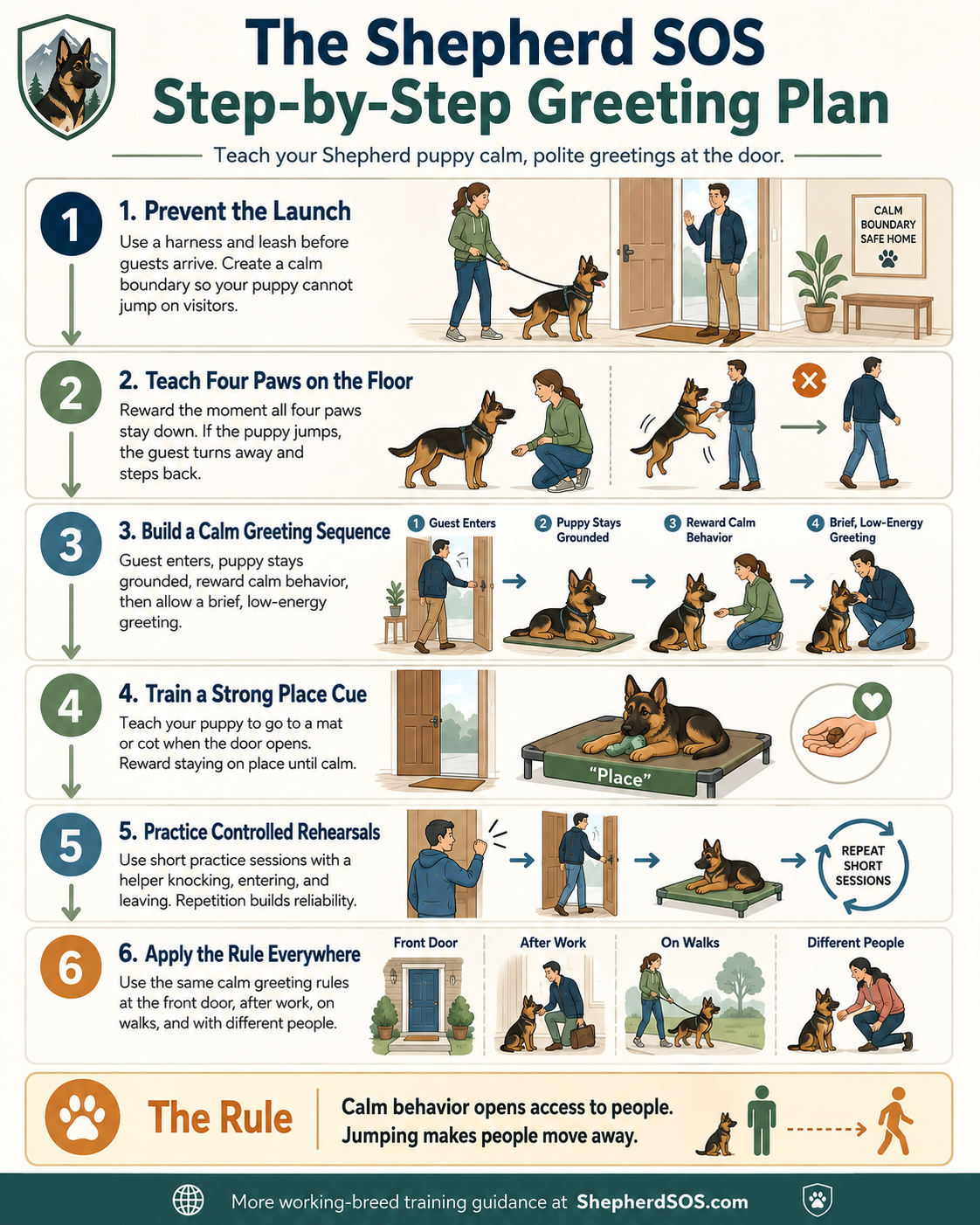
Step 1: Prevent the Launch
Every successful jump strengthens the habit.
Your puppy jumps, reaches the person, receives attention, and learns, “That worked.”
Before an expected visitor arrives:
Put your puppy in their harness and attach the leash.
Position yourself several feet from the door.
Hold the leash or step on a section of it so the puppy can comfortably stand, sit, or lie down but cannot reach the guest.
Keep enough slack to avoid pressure while the puppy is grounded.
Avoid a sudden stop that snaps the puppy downward.
Keep slack while they are grounded and avoid any sudden neck or body jolt.
The leash should create a calm boundary—not become a punishment.
Have the guest enter and ignore the puppy completely. No staring, squealing, reaching down, or repeating the puppy’s name.
Don't start with your most excited friend. Practice first with a calm helper who can follow directions, then gradually increase the challenge.
Step 2: Teach “Four Paws on the Floor”
Your puppy now needs to discover which behavior earns attention.
The moment all four paws are grounded, mark the behavior with a clicker or a calm word such as “yes,” then deliver a treat low to the floor.
Reward placement matters. If you hold food near your chest, you may pull the puppy upward. Deliver it at nose level or between the front paws.
Next, have the guest approach slowly.
If the puppy remains grounded, the guest continues approaching.
If the puppy jumps, the guest turns away and steps back.
When four paws return to the floor, mark and reward.
The guest approaches again.
If the puppy stays grounded, the guest may offer calm chest or under-chin petting.
If the paws lift, the hands disappear, and the guest steps away.
This creates a simple pattern:
Paws down = people come closer.
Paws up = people go away.
AKC training guidance also recommends keeping four paws on the floor and removing attention when jumping occurs.
Do not demand a “sit” every time at first. A calm stand with four paws down is a successful greeting. First, teach grounded behavior. Add precision later.
Step 3: Build a Calm Greeting Sequence
Once the puppy understands that jumping makes the person retreat, use the same routine for every arrival:
The guest enters.
The puppy remains behind the leash boundary.
You mark and reward grounded behavior.
The guest approaches slowly.
The puppy stands or sits calmly.
The guest pets for one or two seconds.
The guest withdraws before the puppy becomes overexcited.
You reward the puppy again at floor level.
Keep early greetings brief. Several two-second interactions are more useful than one chaotic minute.
As your puppy improves, gradually increase petting duration, guest excitement, approach speed, and leash freedom. Change only one difficulty at a time.
Step 4: Train a Strong “Go to Place” Cue
“Place” gives a Shepherd puppy a defined job during human activity.
Begin when no visitors are present:
Toss a treat onto the mat or cot.
When the puppy steps onto it, mark “yes.”
Feed several treats while the puppy stays there.
Release with a word such as “free.”
Repeat until the puppy eagerly moves to the station.
Add the cue “place” just before they move toward it.
Build duration gradually. You can also offer a safe chew, stuffed food toy, or lickable enrichment item exclusively on the place station so the mat predicts decompression.
Then add distance and mild distractions: a knock, a family member entering, a bag being carried inside, or a calm helper sitting down. The AKC describes “go to place” as a practical way to send a dog to a specific location and keep it there briefly.
During real arrivals, send your puppy to its place before opening the door and reward generously for staying there. Once the initial adrenaline drops, you can conduct a controlled greeting.
Some puppies do better without greeting at all. They may be happier relaxing behind a gate with a chew until the visitor becomes boring.
Step 5: Practice Controlled Rehearsals
Real guests do not arrive often enough—or behave consistently enough—to create fast progress.
Ask a helper to knock, enter, leave, and re-enter several times. Later, have them carry a bag, wear a hat, speak, sit down, or stand up again.
Keep sessions short—about five to ten minutes—and end before the puppy becomes mentally exhausted or increasingly frantic.
A session may include ten calm door entries without an actual visit. That is controlled skill-building.
Step 6: Apply the Rule Everywhere
A puppy who stays grounded at the front door may still jump when you return from work, during morning greetings, on walks, at the veterinarian, when released from the crate, or when someone sits on the couch.
Dogs do not automatically apply one lesson to every context. Practice the same pattern with multiple people and in multiple locations.
The words may change, but the rule remains:
Jumping never opens access. Calm behavior does.
Troubleshooting Common Puppy-Jumping Problems
“My Guests Say, ‘I Don’t Mind!’”
The training isn’t only about that guest. A friendly adult may tolerate muddy paws; a child, older relative, injured person, delivery driver, or fearful visitor may not.
If someone refuses to cooperate, use a gate, crate, leash, or separate room. Do not sacrifice weeks of training to avoid an awkward conversation.
“My Puppy Sits, Then Jumps as Soon as Someone Touches Them.”
The touch is too intense or lasts too long.
Ask the guest to move slowly, pet the chest or under the chin, and stop after one or two seconds. Avoid rapid head patting, leaning over the puppy, and excited voices. Reward before the jump happens.
“My Puppy Jumps on Me When I Come Home.”
Use the same rule for yourself. Enter calmly, keep your hands close to your body, and turn away or step behind a barrier if jumping begins.
The instant four paws are grounded, offer calm attention or scatter a few treats on the floor.
You do not need to ignore your puppy for an arbitrary five minutes. The useful lesson is that greetings become available when they are grounded and able to engage without launching.
“My Puppy Jumps and Mouths People.”
Jumping combined with biting, grabbing sleeves, barking, or frantic spinning usually indicates higher arousal. Increase distance, shorten the interaction, use a barrier, and provide a decompression activity.
If the behavior is intense, fearful, unpredictable, or escalating, consult a qualified reward-based trainer or veterinary behavior professional.
Frequently Asked Questions
Why Does My Puppy Jump on Certain People?
Puppies learn individual patterns. Someone who squeals, bends over, waves their hands, pushes the dog, or offers energetic petting may be more reinforcing than someone who enters quietly.
Will My Puppy Grow Out of Jumping?
Do not count on it. Any behavior that continues to earn attention can remain part of the dog’s greeting routine, even as the dog becomes larger and stronger.
Is Jumping a Sign of Dominance?
Friendly greeting jumping is usually better explained by excitement, social access, reinforcement history, and undeveloped impulse control—not an attempt to achieve social rank.
What if My Puppy Is Afraid of Visitors?
Do not force a greeting or lure the puppy close to strangers. Give them distance, allow them to observe from behind a barrier, and seek qualified help if they bark, growl, lunge, hide, freeze, or cannot recover.
The Shepherd SOS Rule: Calmness Unlocks Access
Stopping puppy jumping is not about making your Shepherd less social. It is about teaching them how to access people without losing control of their body.
The complete strategy is simple:
Prevent the jump.
Remove attention when paws lift.
Reward grounded behavior immediately.
Give the puppy a clear alternative, such as place.
Practice with controlled helpers.
Apply the rule consistently everywhere.
The difficult part is not understanding the method. It is coordinating the humans.
When everyone follows the same pattern, the puppy receives a clear message. When guests squeal, push, pet, and then complain, the behavior remains confusing and persistent.
Your Shepherd does not need harsher corrections. They need a greeting system that is easier to understand than the chaos at the door.
Next Steps: Make Every Visitor Part of the Training Plan
Want an easier way to prepare guests before they enter?
Download the free “Puppy in Training” Front Door Sign & Guest Guideand hang it near your entrance. It gives friends and family simple instructions for helping your puppy practice calm, four-paws-on-the-floor greetings from the moment they arrive.
👇 Fill out the form below to get immediate access.
If your Shepherd puppy’s jumping is part of a larger pattern—frantic barking, biting, leash pulling, inability to settle, door reactivity, or complete loss of control around visitors—you may need more than one isolated training technique.
A Shepherd SOS Consult Call gives you a customized plan based on your puppy, household, schedule, environment, triggers, and current routine.
Instead of piecing together generic advice, you will know what to manage first, which skill is missing, and how to practice without making the behavior more intense.
Click here to learn more or book a call now.
Recommended Articles


Stop Shepherd leash pulling, lunging, and leash biting with a practical, reward-based plan for calmer walks, better focus, and safer handling.