
How to Stop Shepherd Resource Guarding: Preventing Possession Aggression
Table of Contents
You walk toward your Shepherd puppy while they are chewing a bone.
Their chewing stops.
Their body suddenly goes rigid. Their head lowers over the prize. Their eyes track you without moving.
Then comes the growl.
For many owners, this is the moment panic sets in.
“Is my puppy becoming aggressive?”
“Do I need to show them who's boss?”
“What happens when this dog weighs 80 pounds?”
Resource guarding can feel frightening—especially when you are raising an intelligent, powerful shepherd or high-drive working breed. But a growl over a bone does not automatically mean your puppy is becoming a dangerous dog.
It means your puppy is communicating something important:
“I am worried you are going to take this.”
The solution isn't to prove you can take it. It is to teach your puppy that they do not need to defend it in the first place.
That distinction changes everything.
Resource guarding is not unique to German Shepherds, Belgian Malinois, Dutch Shepherds, or other working breeds. Any dog can guard something they value.
The behavior can range from simply moving away with an object to freezing, hard staring, growling, snapping, lunging, or biting.
With the right management and training, many mild cases can improve dramatically.
But the process begins with trust—not confrontation.
What Is Resource Guarding?
Resource guarding is a behavior a dog uses to maintain possession of something they consider valuable.
The resource might be obvious:
Food
Bones
Bully sticks
Toys
Stolen socks
Trash
Treats
But dogs can also guard less obvious resources:
A crate
A dog bed
The couch
A doorway
A resting location
Access to another dog
Proximity to a particular person
It can be almost anything a dog wants to control, and warning behaviors can include staring, freezing, hovering over an object, growling, snarling, or snapping.
The mistake is waiting for the growl before recognizing the problem.
Watch for the quieter warning signs.
Your Shepherd may:
Suddenly stop chewing
Lower their head over the object
Eat faster as you approach
Turn their body away from you
Place a paw over the resource
Clamp their mouth tightly around an object
Show the whites of their eyes
Become completely still
Give you a hard, unblinking stare
Carry the object away when someone approaches
These behaviors are information.
A growl is simply louder information.
If those warnings repeatedly fail to make people back away, some dogs learn that stronger behavior—such as lunging or biting—works better.
That is why early intervention matters.
Why Resource Guarding Can Become Serious With Shepherds
Resource guarding isn't exclusive to Shepherds, and not every Shepherd develops it.
But when guarding occurs in a German Shepherd, Belgian Malinois, Dutch Shepherd, or large Shepherd mix, owners should take it seriously.
These dogs mature into powerful animals.
A behavior that seems manageable in a 20-pound puppy can become significantly harder to handle, even impossible, when that puppy becomes a 70-, 80-, or 90-pound adult.
Shepherds are highly observant and learn patterns quickly.
If every time you approach a bone, you reach down and remove it, your puppy may learn:
“Human approaching = I lose my stuff.”
That prediction—not the bone itself—is what you need to change.
The Shepherd SOS goal is to create a completely different expectation:
“Human approaching = something good happens.”
Why Traditional Resource Guarding Advice Can Backfire
Some outdated dog-training advice can unintentionally worsen resource guarding.
Mistake #1: Taking the Food Away to “Show Who's the Alpha/Boss”
You may have heard:
“You should be able to take anything away from your dog whenever you want.”
Eventually, yes—you want a dog who willingly releases objects when asked.
But repeatedly reaching into the bowl, removing food, pulling bones from your puppy's mouth, or bothering them while they eat can create vigilance rather than submissiveness when humans approach.
Think about the lesson from your puppy's perspective.
Every time the human arrives...
Something disappears.
Of course, they start watching your hands.
Mistake #2: Punishing the Growl
Never punish away your warning system.
If your shepherd growls and you yell, alpha roll them, hit them, grab their collar, or physically intimidate them, you may suppress the warning without changing how they feel about your approach.
Now you have a dog who may still feel threatened but has learned that communicating discomfort results in punishment.
Reward-based behavior modification is recommended over physical or psychological punishment.
Use the growl as information and adjust the setup.
Mistake #3: Chasing the Puppy
Your Shepherd grabs a sock.
You run after them.
They sprint away.
You corner them.
They clamp harder.
Now the sock is suddenly the most important possession on Earth.
Chasing can turn stolen objects into trophies and create conflict around possession.
Instead, prevent access to forbidden items whenever possible and teach a reliable exchange instead.
Before You Train: Set Up the Right Environment
Don't start by testing how much your puppy will tolerate.
Start by preventing unnecessary conflict.
You will need:
High-value trade rewards
Use something substantially more exciting than the current resource:
Chicken
Turkey
Small pieces of cheese
Hot dog
Freeze-dried beef liver
Another extremely high-value food your dog tolerates well
Do not underestimate the intelligence of a shepherd or working breed dog. If your puppy is guarding a $10 toy and you offer a milk bone, do not be surprised when they reject your proposal.
Physical management
Depending on the dog and situation, this might include:
Baby gates
Exercise pens
Closed doors
Separate feeding areas
Crates
Strategic furniture placement
A leash or supervised lightweight house line for non-aggressive management situations
Management is not a failure.
Management stops the dog from repeatedly rehearsing the behavior while you build better skills.
Household consistency
Everyone needs the same rules.
Children should never be sent to take food, bones, or toys away from a resource-guarding dog.
In fact, children should not participate in resource-guarding treatment exercises.
Homes with children require especially conservative management because children may miss subtle canine warnings or unintentionally approach a guarded resource.
The Shepherd SOS Resource Guarding Plan
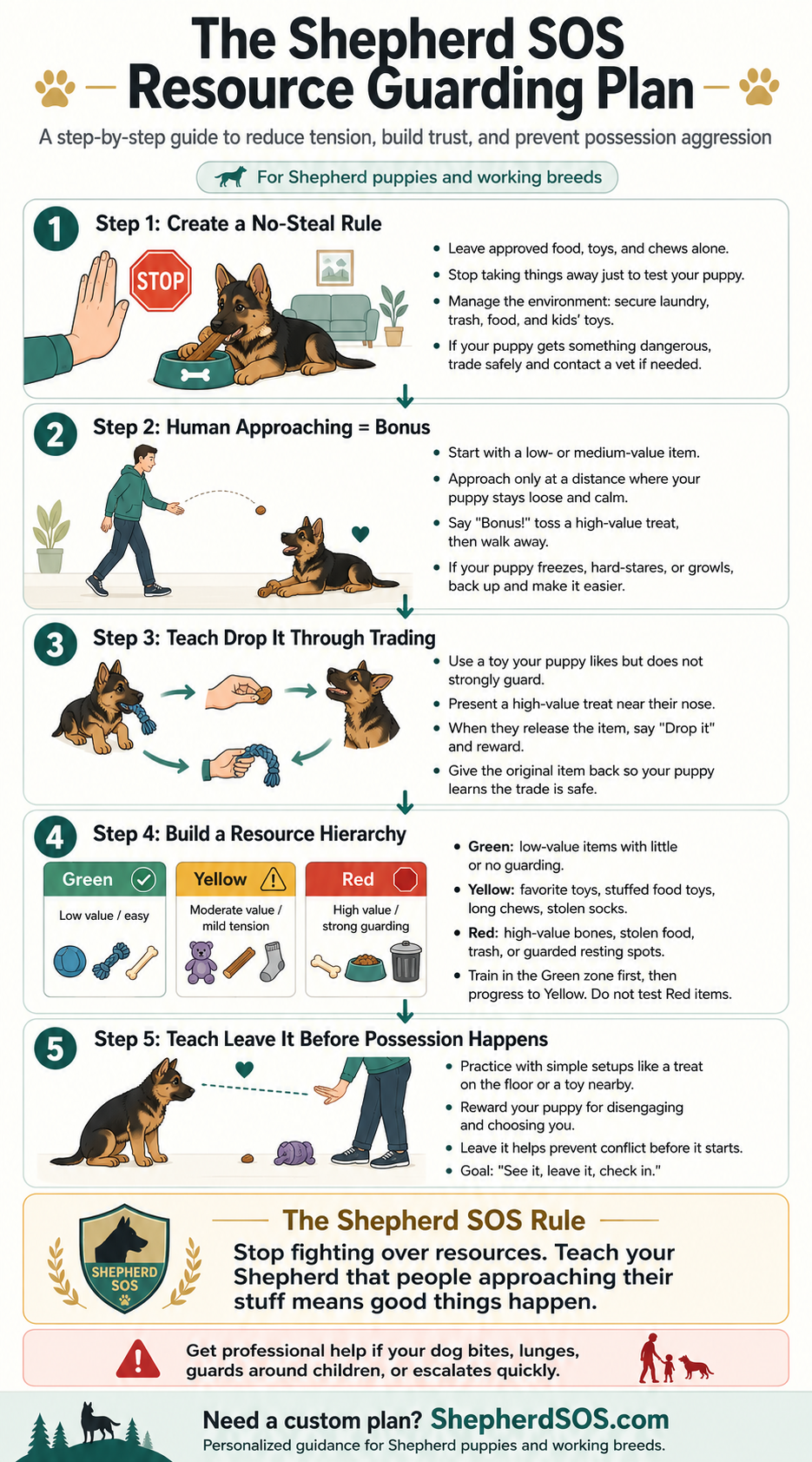
Step 1: Create a “No-Steal” Rule
Stop unnecessarily taking approved items away.
If your puppy is eating their dinner, let them eat.
If they are peacefully chewing an approved chew, let them chew.
If they have a safe toy, you don't need to repeatedly prove you can take it.
Your first goal is to stop reinforcing the prediction:
“People approaching my stuff are dangerous.”
At the same time, manage the environment so your puppy doesn’t have a chance to access YOUR stuff.
Put laundry away immediately, secure trash in lidded bins, keep food off counters, block stairs with a baby gate, secure rooms they’re not allowed in, and keep children’s toys out of reach.
Every stolen sock you prevent is one less resource-guarding confrontation you need to solve.
Step 2: Teach “Human Approaching = Bonus”
Now we change the prediction.
Start with a low- or medium-value resource, not the most valuable bone your dog has ever seen.
Let your puppy settle with the item.
Approach only to a distance where their body remains loose and relaxed.
Maybe that is six feet. Maybe it is ten feet.
Distance is determined by your dog's body language, not by a predetermined number.
Walk past and say something cheerful, such as:
“Bonus!”
Toss a HIGH-value treat toward them.
Then walk away.
Do not say anything else.
Do not touch the resource.
Do not hover.
Do not reach.
You arrived.
A piece of chicken fell from the sky.
You disappeared.
That is the entire lesson.
Repeat these brief sessions until your puppy begins looking happy when you approach instead of becoming tense.
Desensitization and counterconditioning—gradually exposing the dog at a tolerable level while pairing the approach with something desirable—are commonly used strategies for food guarding.
If your puppy freezes, growls, gulps faster, or hard-stares:
You are too close or progressing too quickly.
Back up.
Training happens below the reaction, not through it.
Step 3: Teach “Drop It” Through Trading
Once your puppy is comfortable with you approaching lower-value items, begin teaching voluntary release.
Give them a toy they enjoy but do not intensely guard. Present a high-value treat near their nose.
The moment they release the object, say:
“Drop it.”
Reward them.
Then do the part many owners skip:
Give the object back.
Now the deal becomes:
Drop toy → get chicken → get toy back.
That is a fantastic deal.
Over time, practice with different low- to mid-value objects and gradually increase to high-value toys.
Do not jump from a boring rope toy directly to the marrow bone your dog guards intensely.
Build the skill progressively.
Step 4: Build a Resource Hierarchy
Not every possession has equal value.
Your shepherd may happily surrender a tennis ball but become extremely serious about a bully stick.
Create three categories.
🟩 Green Resources
Little or no guarding.
Examples:
Ordinary toys
Low-value chews
Empty bowls
🟨 Yellow Resources
Mild tension or hesitation.
Examples:
Favorite toy
Stuffed Kong
Long-lasting chew
Stolen sock
🟥 Red Resources
Strong guarding behavior.
Examples:
High-value bone
Raw food
Stolen food
Trash
Specific resting location
Train primarily in the green zone first.
Progress into yellow only when your puppy is consistently relaxed.
Do not use red-zone resources to test whether your training is working.
Severe guarding is not a DIY obedience challenge.
Step 5: Practice “Leave It” Before Possession Happens
“Drop it” handles the object after it enters the dog's mouth.
“Leave it” prevents the battle from starting.
That makes it one of the highest-value skills you can teach a Shepherd puppy.
Practice with controlled setups:
Treat on the floor.
Reward disengagement.
Toy nearby.
Reward choosing you.
Low-value distraction.
Reward turning away.
Over time, you are building a dog who can see an exciting object without automatically needing to possess it.
That is far easier than negotiating over a stolen chicken bone after it is already inside your puppy's mouth.
Common Shepherd Resource Guarding Problems
“My Shepherd Guards the Couch or Bed.”
Do not physically drag them off.
Instead, teach an “off” or “place” behavior when no guarding is occurring.
Reward getting off the furniture.
Reward going to their own bed.
Then temporarily restrict access to problematic locations while you build the skill.
If an adult dog suddenly begins guarding resting spaces or becomes aggressive when touched or moved, schedule a veterinary examination. Sudden behavioral changes can sometimes be associated with pain or another medical issue.
“My Puppy Guards Me From Other Dogs or Family Members.”
Do not reward the guarding by allowing your puppy to control access to you.
If your puppy stiffens, growls, blocks, or threatens another animal or person for approaching you, calmly change the situation rather than petting, reassuring, restraining, or arguing with the dog.
Create distance.
Move yourself if necessary.
Then build structured training around calm behavior when others approach.
Person-directed guarding can become complicated quickly, particularly in multi-dog households, so repeated incidents deserve professional assessment.
“My Puppy Freezes When I Walk Near Their Food.”
Stop.
A freeze is not permission to keep approaching.
It is a warning.
Return to a distance where your puppy can comfortably continue eating.
Your goal is not:
“How close can I get before they growl?”
Your goal is:
“How far away do I need to be for them to feel safe enough to learn?”
That is the Shepherd SOS difference between provoking behavior and actually changing it.
“My Puppy Stole Something Dangerous.”
Safety takes priority.
Do not corner the puppy and start wrestling unless an immediate emergency leaves no alternative.
Instead, scatter or toss extremely high-value food away from the dangerous item so the puppy moves away from it, then secure the object.
Dogs may swallow stolen objects faster when humans rush in to take them, which is another reason prevention and training how to trade matter.
If the dog swallowed medication, a toxin, a sharp object, a battery, or another hazardous item, contact your veterinarian or appropriate veterinary emergency service immediately.
Frequently Asked Questions
Is Resource Guarding a Sign My Shepherd Is Dominant?
Not necessarily.
Resource guarding is much more useful to understand as an attempt to maintain possession of something the dog values than as a battle for leadership.
Trying to “win” the confrontation through intimidation can make the dog more defensive.
You do not need to prove that you own the bone.
You need to teach your puppy that your presence does not predict loss or conflict.
What Should I Do When My Puppy Growls?
Listen.
Stop advancing and give them space.
Then evaluate why the growl happened.
Was the resource too valuable? Were you too close? Did you reach toward them? Had someone taken things away earlier?
The growl tells you that your current training setup exceeded what the puppy could comfortably handle.
Adjust the setup.
Do not punish the warning.
How Long Does Resource Guarding Training Take?
There is no universal timeline.
A puppy showing mild tension around a chew may improve relatively quickly with good management and consistent training.
A dog with months or years of guarding history, multiple guarded resources, escalating aggression, or a bite history may require a much longer behavior-modification plan.
Measure success through body language and behavioral change—not a calendar.
When Resource Guarding Requires Professional Help
Do not attempt advanced resource-guarding exercises by yourself if your shepherd:
Has bitten someone
Has attempted to bite
Charges people away from resources
Guards multiple areas of the house
Guards unpredictably
Guards from children
Escalates rapidly from freezing to snapping
Has caused fights between household dogs
Becomes aggressive when physically handled
Suddenly develops guarding behavior as an adult
Professional assistance is recommended when a dog is likely to bite or has a bite history.
Do not allow children to participate in food-guarding treatment exercises.
A qualified behavior professional should be involved in serious aggression cases.
There is a big difference between training an eight-month-old puppy to trade a toy and rehabilitating a powerful adult dog with an established bite history.
Respect that difference.
The Shepherd SOS Rule: Stop Fighting Over Resources
Resource guarding rarely improves because the owner becomes better at taking things.
It improves when the dog becomes less worried about losing them.
That means less confrontation, better management, better trades, clearer communication, more attention to body language, and fewer opportunities to rehearse the problem.
Your Shepherd does not need to learn that you are strong enough to take the bone.
They need to learn something far more valuable:
They are safe when you approach it.
That is how you move from conflict to cooperation.
And with a powerful working dog, cooperation will always take you further than intimidation.
Build Your Resource Guarding Training Plan
If you are dealing with early resource guarding, guessing which objects to train around—or how close you should get—can push your puppy too far, too fast…
Download the free Shepherd Puppy Resource Guarding Blueprint to rank your dog's food, toys, chews, stolen objects, resting spaces, and other high-value resources from lowest to highest value.
Then identify the distance at which your Shepherd stays relaxed so you can begin training without repeatedly triggering the very behavior you are trying to change.
👇 Fill out the form below to get immediate access.
If resource guarding is already affecting daily life—or you are worried about making the wrong move—you don't have to piece together a plan through trial and error.
A Shepherd SOS Consult Call looks at the bigger picture: your puppy’s triggers, environment, routine, arousal level, management, communication, guarded resources, and the exact moments when behavior begins to change.
Instead of asking, “What generic resource-guarding technique should I try next?” You can build a plan around the shepherd actually living in your home.
Get personalized shepherd puppy behavior guidance with Shepherd SOS.
Because when an intelligent working dog is telling you something is wrong, the goal should not be to silence the warning.
The goal is to understand it—and build a dog who no longer feels the need to give it.
Click here to learn more or book a call with Coach Doug today.
Recommended Articles


Stop Shepherd leash pulling, lunging, and leash biting with a practical, reward-based plan for calmer walks, better focus, and safer handling.