
The New Shepherd Puppy Checklist & First 30-Day Survival Blueprint
Table of Contents
Bringing home a shepherd puppy is vastly different from bringing home a golden retriever or a companion breed.
German Shepherds, Belgian Malinois, Australian Shepherds, Dutch Shepherds, and other high-drive working breeds are highly intelligent and learn quickly. Unfortunately, they learn unwanted patterns just as quickly as good ones.
They process information at lightning speed, possess a deep genetic urge to herd or guard, and constantly scan their environment for direction.
If you do not proactively give your shepherd puppy a job, they will invent one for themselves.
That “job” might be patrolling your windows, herding your children, shredding your rugs, stealing your shoes, chasing smaller animals, biting your ankles, or sounding the alarm every time a neighbor or delivery driver walks by.
For a busy owner, managing this intensity can feel overwhelming. However, shepherds do not need you to be home 24/7; they need consistency, clear boundaries, and predictability.
The first 30 days with a puppy are not about achieving perfect obedience. Your priorities are simpler:
Prevent dangerous habits. Build a predictable routine. Protect sleep—reward calm behavior. Teach your puppy how to live in your home.
This comprehensive guide gives you the best gear, daily structure, and week-by-week plan you need to survive the chaotic first month without turning puppy care into a full-time job.
The Essential Gear Checklist: Your New Puppy Starter List
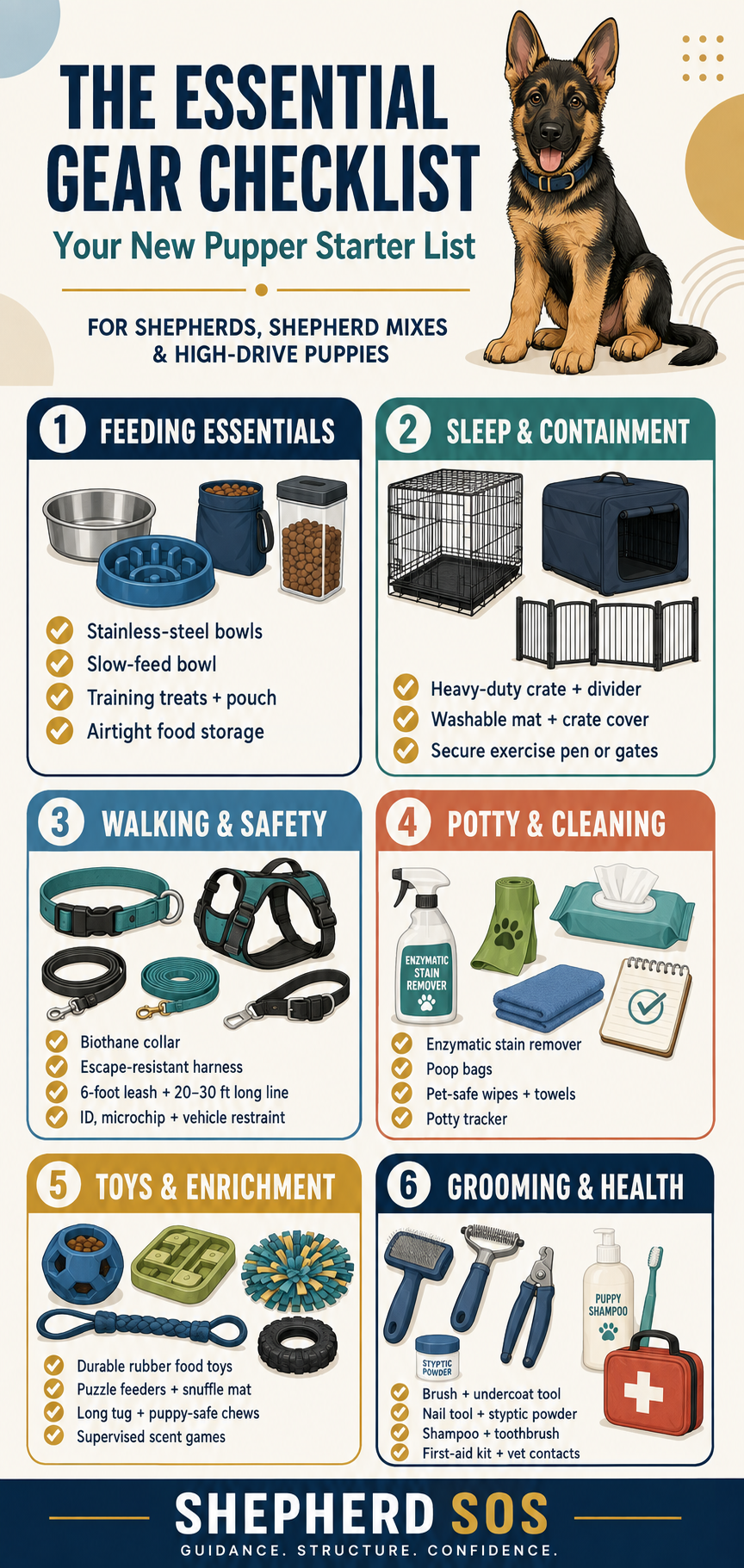
Do not waste money on flimsy, novelty products. Shepherd puppies will easily destroy cheap plush toys and bypass flimsy plastic barriers.
This new puppy starter list focuses on durable, high-utility equipment designed specifically for working breeds to grow with.
Feeding Essentials
Heavyweight stainless steel bowls: Choose durable, easy-to-sanitize bowls that cannot be chewed like plastic.
Slow-feed maze bowls: Force your puppy to slow down their eating and turn mealtime into an instant brain game.
High-value training treats: Stock up on small, freeze-dried beef liver or air-dried meat treats to reward positive behaviors during training sessions.
Dog treat training pouch: Provides immediate access to rewards for check-ins, calm behavior, crate entry, and successful potty trips.
Airtight food storage: Protect food freshness and prevent a clever puppy from helping themselves to it.
Choose a nutritionally complete puppy food appropriate for your puppy’s anticipated adult size with guidance from your veterinarian. (Blog Post on puppy nutrition and recommended puppy food)
Use part of each meal for training rather than adding unnecessary calories through endless treats.
Sleep & Containment
Heavy-duty metal crate with a divider panel: Buy for the anticipated adult size, then adjust the sleeping area as your puppy grows.
Durable chew-proof crate pad: Avoid dog beds early on, as teething shepherd puppies will tear them open and potentially swallow the stuffing.
Breathable crate cover: Reduces visual stimulation to help an overstimulated puppy calm down and sleep soundly.
Secure exercise pen or hardware-mounted gates: Create a supervised play zone while you work or complete household tasks.
Place one crate near a daily household activity, and consider setting up a second sleeping area near your bedroom during the first few nights.
Containment is not punishment. It prevents rehearsals of counter-surfing, destructive chewing, potty accidents, and frantic household patrols.
👉 Read next: How to Stop Shepherd Puppy Crate Screaming
Walking & Safety Basics
Weatherproof Biothane flat collar: Choose a secure, properly fitted collar that withstands mud, rain, and daily wear.
No-pull adjustable harness: Use a comfortable, escape-resistant fit that allows natural shoulder movement.
Standard 6-foot nylon leash: Use this for daily walks, potty trips, and close-range training.
30-foot Biothane long training line: Practice recall and controlled exploration without unsafe off-leash freedom.
Dual-engraved stainless steel ID tags: Ensure your current phone number and "Microchipped" status are stamped onto a noiseless, silicone-rimmed tag.
Travel crate or appropriate vehicle restraint for safe transportation.
Potty & Cleaning Supplies
Enzymatic stain remover: Completely breaks down urine residue that ordinary cleaners leave behind and prevents your shepherd from marking the same spot twice.
Poop bags with dispensers: Keep these by every exit and attach one to each leash.
Pet-safe wipes and towels: Clean muddy paws and underbellies before your puppy races through the house.
Place leashes, shoes, treats, and cleanup supplies beside the exit to remove delays when your puppy wakes.
Limit puppy pad use unless you intentionally want an indoor toilet area because mixed surfaces can slow outdoor training.
You are the schedule, the signal, and the safety net. If accidents cluster after play, meals, drinking, or waking, take your puppy out 10–15 minutes earlier during the next cycle.
👉 Read next: The Shepherd SOS Fast-Track Potty Training Guide.
Toys & Mental Enrichment
Classic KONG rubber toys: Buy multiple black "KONG Extreme" toys, stuff them with wet food, and freeze them for long-lasting, soothing mental distractions.
Puzzle feeders & snuffle mats: Use interactive dispensers that require your puppy to work to access their kibble.
Long tug toys: Keep teeth away from hands while teaching start, drop, and finish cues.
Puppy-safe chews: Offer appropriate chewing surfaces and rotate them to keep interest high.
Unstuffed canvas crinkle toys: Satisfy your puppy's natural predatory drive with flat, squeaker-free toys that eliminate the risk of swallowing synthetic stuffing.
Offer cardboard searches, scatter feeding, and scent games under supervision for inexpensive mental work.
Remove damaged toys immediately if pieces could be swallowed.
More stimulation is not always better. A frantic shepherd puppy may need sleep and a downshift—not another round of fetch.
Grooming & Health Care
Brush and undercoat tool: Introduce short brushing sessions before adult shedding makes grooming harder.
Ergonomic scissor-style nail clippers: Introduce nail trims immediately to keep their claws short, straight, and structurally sound.
Styptic powder: Keep this first-aid powder nearby to stop bleeding if you accidentally clip a nail too short.
Puppy shampoo: Build cooperative hygiene habits through short, positive repetitions.
Practice handling sessions with paws, ears, mouth, tail, collar, and gentle brushing.
Schedule a veterinary examination promptly to discuss nutrition, vaccinations, parasite prevention, microchipping, and breed-specific health concerns.
Ask your veterinarian which public environments are appropriate for your puppy based on your puppy’s age, vaccination history, health, and local disease risk.
Store emergency clinic information and poison-control numbers where every household member can find them.
Vaccination recommendations should be individualized by your veterinarian based on age, lifestyle, location, and exposure risk, in accordance with the ccurrent AAHAcanine vaccination guidelines.
The 30-Day Week-by-Week Survival Blueprint
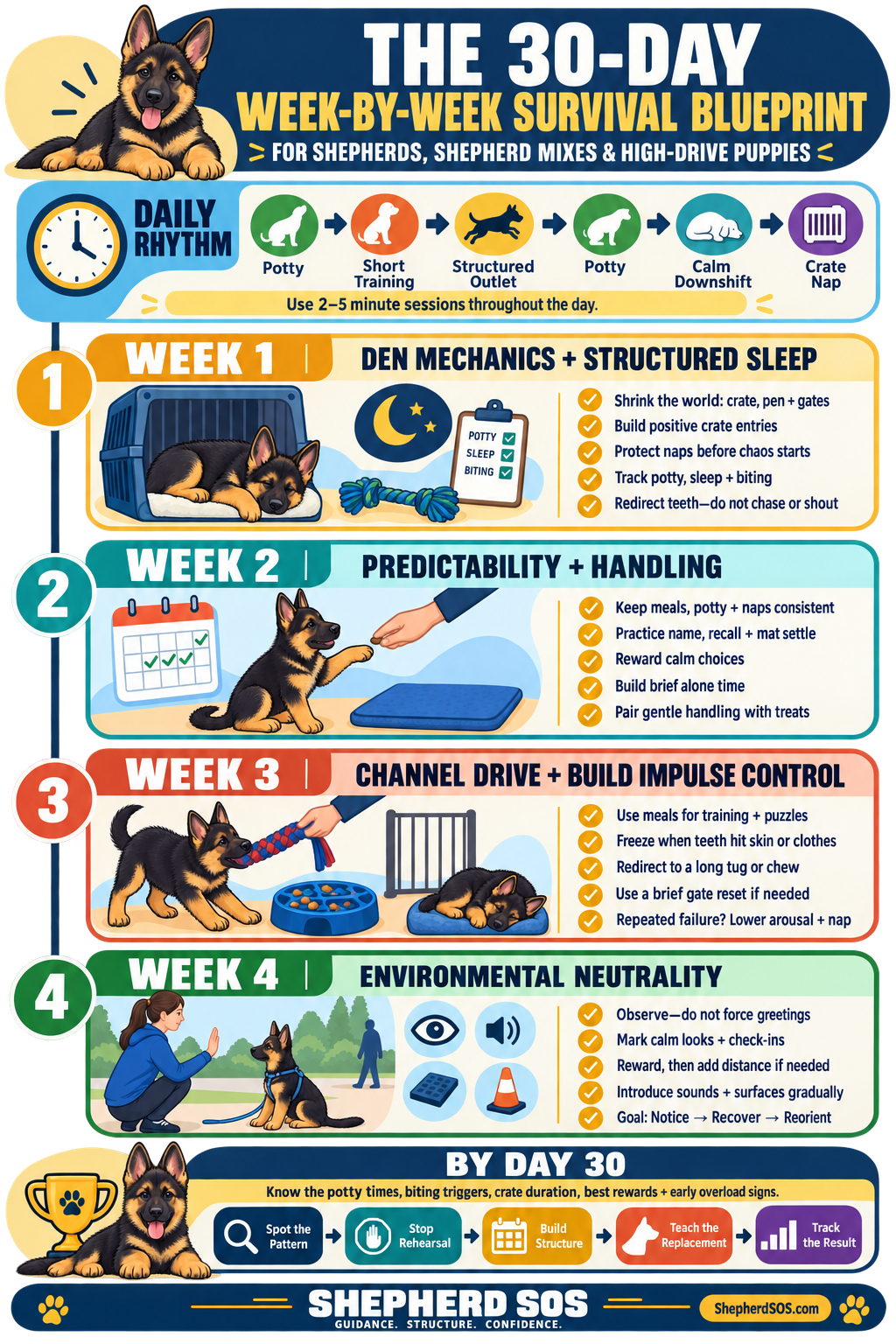
Successfully navigating the first 30 days with a puppy means treating every interaction as a training moment.
Shepherds learn constantly. If you do not actively teach them what is right, they will quickly figure out how to manipulate their environment for their own entertainment.
Use this structured week-by-week timeline to balance your professional workload with your puppy's critical developmental phases.
Week 1: Den Mechanics and Structured Sleep
Your first job is to make your puppy’s world smaller.
The primary goal for the first seven days is to establish the crate as a safe, high-value haven while preventing separation anxiety. Your puppy is adapting to a new environment, and establishing clear boundaries provides reassurance rather than restriction.
Use the crate, pen, gates, and supervised house line to prevent wandering. Freedom should be earned gradually through successful behavior—not granted because the puppy appears bored.
Build the crate mechanically.
Make the crate an active jackpot zone. Toss high-value treats inside and let the puppy run in to eat them, leaving the door open.
Feed meals inside and close the door while your puppy is distracted. Release when finished and only during a calm moment.
If they whine or bark, wait for a minimum of three full seconds of absolute silence before opening the door. Opening the door while they scream explicitly teaches them that barking unlocks freedom.
Protect structured naps.
Young shepherd puppies need far more sleep than owners realize. When biting, zooming, barking, and attacks on clothing intensify, schedule a potty break and quiet nap routine.
Start your potty record.
Track waking, eating, drinking, playing, training, crating, successful elimination, and accidents. Patterns usually become visible within several days.
Redirect mouthy herding behavior early.
Freeze movement, remove access to skin or clothing, and redirect your puppy to a tug, a chew, a food search, or a short, calm break. Do not turn ankle-biting into an exciting chase.
Keep exposure controlled.
Let your puppy observe household sounds, surfaces, people, and safe environments without forcing interaction.
Your Week 1 goal is not obedience. It is a puppy who begins to predict where to sleep, where to eliminate, what to chew, and how good behavior earns access to the world.
Week 2: Predictability and Handling Foundations
This week focuses on establishing a predictable household routine.
When a shepherd puppy knows their routine, their ambient anxiety drops, resulting in significantly fewer stress-induced behaviors such as pacing, whining, or destructive chewing.
Keep wake-up times, meals, potty trips, training blocks, and naps reasonably consistent.
Teach high-utility skills.
Focus on the puppy’s name, hand targeting, recall foundations, sit, release cues, trading objects, leash following, and settling on a mat.
Reward voluntary eye contact and four paws on the floor.
Make calmness valuable.
Place food between your puppy’s paws when they lie down without being asked. Reward relaxation before your puppy becomes disruptive.
Use food to teach cooperation.
Ask for one easy behavior before opening doors, putting down meals, beginning play, or allowing access to the yard. The goal is not rigid control; it is helping your puppy pause and think.
Build alone time gradually.
Use short crate periods after potty, activity, and a calm downshift. Vary your departure cues so shoes, keys, and closed doors do not always predict a long absence.
Track biting triggers.
Note whether mouthiness appears during overtiredness, frustration, movement, petting, hunger, or transitions. Then change the setup before the behavior starts.
Initiate Cooperative Handling Drills
Your puppy must eventually tolerate routine grooming and veterinary care. Spend a few minutes on cooperative handling:
Gently touch one easy area, such as the shoulder or front paw.
Mark the contact with "Yes" or a click before the puppy pulls away.
Deliver a high-value treat immediately.
Repeat briefly with the ears, muzzle, tail, and body as comfort improves.
If your puppy freezes, avoids, pulls away, or growls, stop and make the next repetition easier.
👉 Read next: How to Stop Shepherd Puppy Biting During the “Land Shark” Phase.
Week 3: Channeling Drive and Impulse Control
By week three, many puppies begin to show their natural herding, chasing, vocal frustration, and mouthiness.
Your main focus shifts to high-drive puppy training that builds reliable impulse control.
Trade the Food Bowl for Mental Enrichment Exercises
A puppy finishes its meal in about 30-45 seconds from a bowl, leaving its brain completely unexercised.
Instead, use one of their meals for training by having them hunt for it in a puzzle feeder, on a snuffle mat, on a grass lawn, or in a frozen KONG toy.
This turns mealtime into an intense mental workout that tires them out, without any extra work for you.
Master Bite Redirection
Shepherd puppies herd and explore using their teeth. When they bite your hands or clothing, they are practicing their genetic prey drive.
Screaming and jumping back make you a more exciting target, which accelerates their drive.
Instead, employ a strict redirection strategy:
Stop all motion immediately and keep your body still and silent.
Present a durable rubber toy or a long tug directly into their mouth.
The moment their teeth clamp down on the toy instead of your skin, praise them warmly and gently tug the toy to make it come alive.
If the puppy tries to bite you again, immediately step over a puppy gate or close a door to put yourself in a brief 30-second time-out.
This teaches them that biting human skin instantly ends the fun interaction.
Repeated redirection failures usually mean the environment is too stimulating or the puppy needs sleep.
Week 4: Environmental Neutrality and Confidence Building
Socialization does not mean forcing your puppy to interact with everyone and everything.
Repeated on-leash greetings can teach a shepherd puppy that every distraction is their business, creating a frustrated dog that barks and jumps because it desperately wants to greet everyone.
This week, focus on training environmental neutrality, which is noticing the world without needing to chase it, greet it, hide from it, or control it.
Train for Environmental Neutrality
Your goal is to teach your puppy to look at strange things, accept their presence calmly, and choose to focus back on you.
Visit veterinary-approved locations and work where your puppy can observe while still eating, sniffing, responding, and recovering quickly.
Let the puppy notice a person, a dog, a sound, or a moving object.
Mark calm observation or a voluntary check-in.
Deliver a high-value reward, then create more distance if arousal rises.
Do not carry a hesitant puppy into crowds or force greetings. Match exposure to your puppy's comfort and reward calm observation.
You are teaching your puppy that quietly observing the world is highly profitable, while also building a default habit of looking to you for direction and approval.
Introduce Novel Textures and Sounds
Build your puppy's confidence by safely exposing them to different sounds and surfaces at home.
Open an umbrella indoors while dropping treats on the ground.
Run the vacuum cleaner in an adjacent room while feeding your puppy their favorite wet food.
Encourage them to walk up and down stairs and across various surfaces.
This expands their comfort zone early, preventing fearful or reactive behaviors from surfacing later in life.
👉 Read next: How to Stop Shepherd Puppy Alert Barking and Early Reactivity
After The First 30 Days
By the end of week 4, you should know your puppy’s common potty times, biting triggers, comfortable crate duration, favorite reinforcers, and early signs of overstimulation.
Use that information to add freedom carefully.
Allow 10–15 supervised minutes in one puppy-proofed room after potty and exercise. If your puppy remains calm, slowly increase access. If destruction, accidents, chasing, or patrol behavior returns, reduce freedom without anger.
Begin linking skills together:
Walk to the door without pulling.
Pause while the door opens.
Follow you outside.
Eliminate in the correct area.
Complete a short sniff or training session.
Return indoors and settle.
Review the month using the Shepherd SOS sequence:
Spot the pattern → Stop the rehearsal → Build structure → Teach the replacement → Track the result
Do not attack ten problems at once. Choose the two or three behaviors that create the most stress and build your next month around them.
Common Problems During the First 30 Days
“My Puppy Screams in the Crate”
Confirm that your puppy has eliminated, has had appropriate activity, and is not distressed by pain, illness, heat, or another physical issue.
Practice easier crate repetitions during the day. Feed inside, close the door briefly, remain nearby, and release during a quiet moment. Avoid using the crate only when you leave.
Persistent panic, attempts to escape, heavy drooling, self-injury, or escalating distress require professional guidance—not a “cry it out” contest.
“My Puppy Bites Harder When I Redirect”
The puppy may be overtired, overexcited, or too aroused to engage with the replacement toy.
Stop moving, reduce stimulation, guide the puppy to a safe, contained area, offer a calming chew, and schedule a nap. Redirection works best before the puppy reaches the frantic stage.
“Potty Training Was Going Well, Then Regressed”
Look for schedule changes, excessive freedom, missed signals, surface preferences, stress, gastrointestinal problems, or urinary symptoms.
Return to close supervision and frequent, predictable trips. Contact your veterinarian if accidents are accompanied by straining, increased frequency, diarrhea, unusual thirst, discomfort, or other changes in health.
“My Puppy Jumps on Everyone”
Prevent rehearsal with a leash, gate, pen, or distance. Reward four paws on the floor before the person approaches.
If jumping makes people talk, touch, push, or wrestle with the puppy, it is still earning attention.
👉 Read next: How to Stop a Shepherd Puppy From Jumping: Calm Greeting Training for Working Breeds
“My Puppy Pulls and Lunges on Walks”
Lower the difficulty. Practice following you indoors, in the driveway, or in a quiet area before expecting polished behavior around dogs, traffic, and wildlife.
Use shorter walks, more sniffing, faster reinforcement, and greater distance from triggers.
👉 Read next: How to Stop Shepherd Leash Pulling
“My Puppy Growls Over Food or Toys”
Do not punish the growl or forcibly remove the item. A growl communicates discomfort; suppressing it can remove an important warning without changing the underlying emotion.
Use controlled trades, reduce conflict, and seek qualified help—especially if guarding escalates, involves children, or includes snapping or biting.
👉 Read next: The Shepherd SOS Resource Guarding Plan.
Conclusion: Your First Month Is About Patterns, Not Perfection
Raising a high-drive shepherd puppy while managing a busy schedule of your own is undeniably challenging.
It requires immense discipline, unwavering structure, and daily commitment.
However, the effort you invest during these critical first 30 days sets the foundation for the rest of your dog's life.
It gives your puppy a reliable crate routine, appropriate outlets, protected sleep, clear household boundaries, safe environmental exposure, and a human who can spot patterns before they become habits.
Stay patient, keep your boundaries consistent, and watch your puppy develop into the elite, loyal companion you always wanted.
If you are unsure which problem to address first, Shepherd SOS can help you turn the chaos into a practical plan.
During a Shepherd SOS Consult Call, Coach Doug can review your puppy’s behavior, daily routine, household environment, work schedule, and biggest pressure points—then help you prioritize the two or three changes most likely to create immediate relief.
Stop guessing. Build a plan designed for your puppy and your real life.
Book your Shepherd SOS Consult Calland start building the calm, confident shepherd you wanted from the beginning.
Recommended Articles



Stop Shepherd leash pulling, lunging, and leash biting with a practical, reward-based plan for calmer walks, better focus, and safer handling.